How To Calculate Lot Size For Gold From Your Stop Loss
How to calculate lot size for gold comes down to one line of arithmetic, and it starts with the stop, not the account.
Most traders do it the other way round. They pick a lot size that feels right, place the trade, then look at where the stop should go. On gold, with its wide swings, that order is how one bad trade turns into a damaged account.
The professional order is simple. Decide your risk in dollars. Measure your stop in dollars of price. Divide. This guide walks through that formula with real numbers, shows why the same risk gives very different lot sizes on different charts, and explains why we treat lot size as the most important decision in any trade.
[BANNER: Gold H4 panel with a live ticket showing entry, stop loss and three targets]
1. The Gold Lot Size Formula
On most brokers, one standard lot of gold (XAUUSD) is 100 ounces. That means every $1 move in the gold price changes the value of one standard lot by $100.
So the formula is:
Lot size = Risk in dollars / (Stop distance in dollars x 100)
| Term | What it means | Example |
|---|---|---|
| Risk in dollars | How much of your account you accept losing if the stop is reached | $50 |
| Stop distance | Entry price minus stop price, in dollars of gold price | $5.00 |
| 100 | Ounces in one standard lot | 100 |
| Lot size | The size that matches your risk | 50 / (5 x 100) = 0.10 lots |
If gold is at 4,035.00 and your stop is at 4,030.00, the stop distance is $5.00. With $50 at risk, the answer is 0.10 lots.
Contract sizes can differ between brokers, so check yours once in your platform’s symbol specification. If your broker uses a different contract size, replace the 100 in the formula with that number.
2. Measure The Stop In Dollars, Not Points Or Pips
This is where most gold lot size mistakes start.
Brokers quote gold with two or three decimals, so “points” and “pips” mean different things on different platforms. One broker’s 500 points is another broker’s 50 pips, and both mean the same $5.00 move.
The simple fix is to ignore points and pips on gold altogether. Take the entry price, take the stop price, and subtract. The answer in dollars of gold price is the only number the formula needs.
Every Direction Sniper ticket shows the entry and the stop as prices on the panel before you enter, so this step takes seconds. The stop distance is known before the trade exists, which means the lot size can be too.
3. Start With Risk: 0.5 Percent, Not “What Feels Right”
We risk at most 2 percent per trade, usually 0.5 percent. The bigger the account, the smaller the percentage tends to be.
At 0.5 percent, a run of losing trades is uncomfortable, not dangerous. It takes a very long losing streak to do real damage, which gives you time to stop, review and adjust.
Here is what 0.5 percent risk looks like on three account sizes, all with the same $8.00 stop on gold.
| Account | Risk at 0.5 percent | Stop distance | Lot size |
|---|---|---|---|
| $1,000 | $5 | $8.00 | 0.006, too small for a standard account |
| $10,000 | $50 | $8.00 | 0.06 lots |
| $50,000 | $250 | $8.00 | 0.31 lots |
Two rules come out of that table.
- Always round down. 0.0625 becomes 0.06, never 0.07. Rounding up quietly raises your risk on every trade.
- Small accounts need smaller units. On a $1,000 account, the right size is smaller than the 0.01 lot minimum most standard accounts allow. That is a sign to use a different account type, not a reason to take a bigger risk.
4. Same Risk, Different Chart, Very Different Size
The stop on a 15 minute ticket is much closer to entry than the stop on a 4 hour ticket. That changes the lot size, even when the risk in dollars is exactly the same.
Here is $50 of risk on three gold tickets.
| Entry chart | Stop distance | Lot size for $50 risk |
|---|---|---|
| 15 minute | $4.00 | 0.12 lots |
| 1 hour | $8.00 | 0.06 lots |
| 4 hour | $20.00 | 0.02 lots |
Same account, same risk, and the 15 minute size is six times the 4 hour size. If the 15 minute ticket reaches its stop, you lose $50. If the 4 hour ticket reaches its stop, you also lose $50.
This is the mistake that blows up accounts: using the same lot size on every trade. A trader who uses 0.12 lots on every chart risks $50 on the 15 minute ticket and $240 on the 4 hour ticket, without noticing.
Fix the risk. Let the lot size change.
5. Small Accounts: Use A Cent Account
If your account is around $100 to $1,000, most gold stops will call for a size below 0.01 lots at 0.5 percent risk. Forcing 0.01 lots on a small account can mean risking 5 or 10 percent on a single trade.
A cent account solves this. Balances are shown in cents, so a much smaller real position becomes possible, and the formula works the same way.
For small balances we recommend a RoboForex Cent account or an XM Micro account. These are partner links, so we may receive a commission at no cost to you.
Prove the method on a small account first. Scale up once sizing every trade has become a habit you never skip.
6. Use The Calculator Every Time
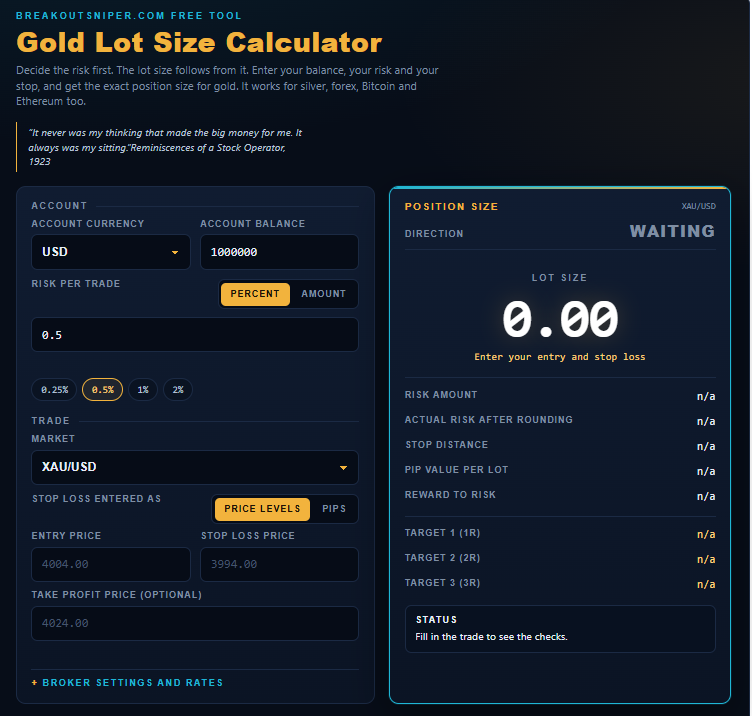
You do not need to do the arithmetic by hand on every trade. Our free gold lot size calculator does it in seconds: enter your account balance, your risk percentage and your stop distance, and it gives you the lot size.
It also covers silver, all 28 forex pairs, Bitcoin and Ethereum, so the same habit works on every market you trade.
7. The Panic Test
Here is the simplest check on whether your lot size is right.
If you are panicking during a trade, the lot size is still too big.
A correctly sized trade lets you watch price move toward your stop without reaching for the close button. When the size is right, a loss is a cost of doing business. When the size is wrong, every candle feels like a threat, and that is when traders move stops, close good trades early and take revenge trades after a loss.
Technical analysis is a game of probability, and there is no holy grail. No method wins every trade. Lot size is what decides whether a losing trade is a small cost or a disaster.
8. The Five Second Lot Size Checklist
- What is my risk in dollars? Start at 0.5 percent of the account.
- What is my stop distance? Entry price minus stop price.
- Lot size = risk / (stop distance x 100). Use the calculator.
- Round down, never up.
- Would I panic if price moved to my stop? If yes, make it smaller.
Know The Stop Before The Trade Exists
The formula only works if you know where the stop is before you enter. That is the part most traders guess.
Direction Sniper removes the guess:
- Direction. One verdict from the 4 hour and the daily, so you only size trades in the direction the bigger charts support.
See our guide to multi timeframe analysis for gold. - Bounces that are not reversals. When the fast charts turn against the trend, the verdict holds, so a sharp bounce does not tempt you into a second, oversized trade.
- The stop loss. Every ticket arrives with its entry, stop and three targets marked, so your stop distance, and your lot size, are known before you place the order. The panel then calculates and displays the trailing stop level as the trade develops, and you move your own stop to match it.
Want to see sizing in action every day? Join The Daily Sniper Read, free, every trading day. Each read shows the panel’s tickets with entry and stop, and walks through the lot size.
See Direction Sniper for Gold and Silver
More guides on reading direction, managing trades and sizing positions: Trading Guides.
Gold Lot Size: Frequently Asked Questions
1How do you calculate lot size for gold?+
Divide your risk in dollars by the stop distance in dollars multiplied by 100, the ounces in one standard lot. With $50 of risk and a $5.00 stop, that is 50 / (5 x 100) = 0.10 lots.
Check your broker’s contract size once. If it is not 100 ounces, replace the 100 with your broker’s number.
2How much is a $1 move on 1 lot of gold?+
On a standard contract of 100 ounces, a $1 move in the gold price changes the value of one lot by $100. On 0.10 lots it is $10, and on 0.01 lots it is $1.
Contract sizes can differ between brokers, so confirm it in your platform’s symbol specification.
3Should I measure my gold stop in points, pips or dollars?+
Use dollars of gold price. Brokers quote gold with different decimals, so points and pips mean different things on different platforms.
Subtract the stop price from the entry price. The answer, such as $5.00, is the only stop number the formula needs.
4How much should I risk per gold trade?+
We risk at most 2 percent per trade, usually 0.5 percent. On a $10,000 account, 0.5 percent is $50.
At that level a run of losing trades is uncomfortable, not dangerous. These figures are for illustration, not a recommendation about how much anyone should trade.
5Why is my lot size different on the 15 minute and 4 hour charts?+
Because the stops are different. With $50 of risk, a $4.00 stop on a 15 minute ticket gives 0.12 lots, while a $20.00 stop on a 4 hour ticket gives 0.02 lots.
The risk stays the same and the lot size changes. Using one lot size on every chart quietly changes your risk from trade to trade.
6What if my account is too small for 0.01 lots on gold?+
On a small account, the correct size at 0.5 percent risk is often below the 0.01 lot minimum. Forcing 0.01 lots can mean risking 5 or 10 percent on one trade.
A cent account solves this, because it allows much smaller positions. For small balances we recommend a RoboForex Cent account or an XM Micro account.
7Should I round my gold lot size up or down?+
Always round down. If the formula gives 0.0625 lots, use 0.06, never 0.07.
Rounding up raises your risk a little on every trade, and over many trades that adds up.
8How does Direction Sniper help with lot size?+
Every Direction Sniper ticket shows the entry and the stop loss as prices before you enter, so the stop distance, and your lot size, are known in advance.
Put the stop distance into the gold lot size calculator and you have your size in seconds. You place and size the order yourself.
THE DAILY SNIPER READ
See the entry, the stop and the lot size, every trading day.
Free in your inbox. Real Direction Sniper tickets, read and sized.
Disclaimer: This guide explains how we calculate position size on gold. It is educational content, not financial advice and not a trade signal service. All prices, stop distances and lot sizes are arithmetic for illustration, depend on your broker’s contract size and account type, and are not a recommendation about how much anyone should trade. Price reaching a published target level is not the same as a realised result. Trading gold and other leveraged products carries risk, and you should only trade money you can afford to lose.