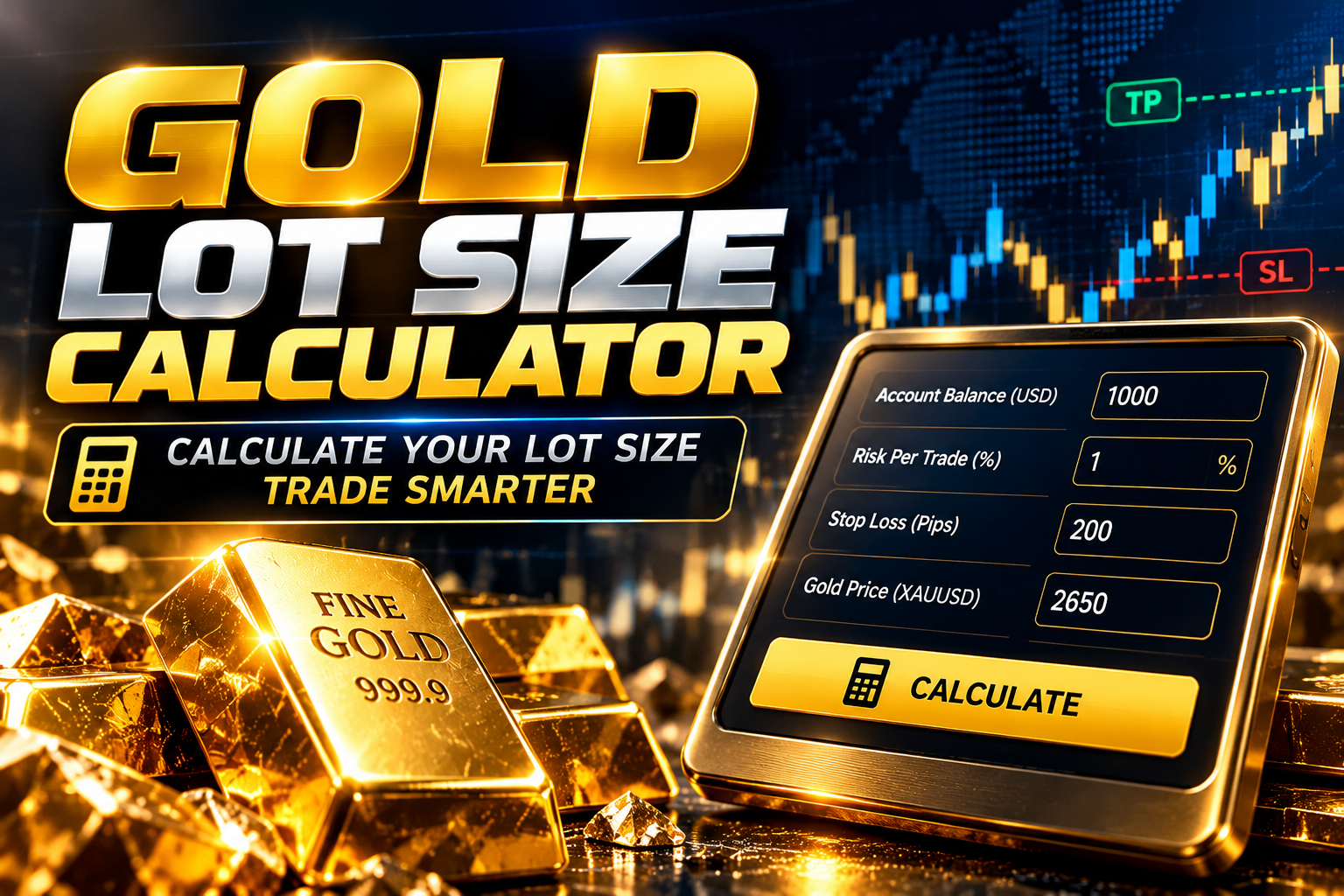
 This gold lot size calculator gives you the exact position size for XAUUSD before you place the order. Enter your balance, how much you are willing to risk, and your stop. The lot size follows from that.
It works the same way on silver, the 28 major and cross forex pairs, Bitcoin and Ethereum.
Most traders do it the other way round. They pick a lot size that feels right, then hope the stop holds. On gold, where price can move ten dollars in minutes, that is how accounts get hurt.
Decide the risk first. Then size the trade.
Gold Lot Size Calculator
Stop loss entered as
Broker settings and rates
1. How To Use The Gold Lot Size Calculator
It takes under a minute.
- Account. Choose your account currency and type your balance.
- Risk per trade. Pick a percentage (0.5% is a sensible default) or type a fixed amount.
- Market. Choose XAU/USD for gold. Every other market is in the same list.
- Entry and stop. Type your entry price and your stop loss price. The calculator works out the direction by itself: a stop below the entry is a buy, a stop above the entry is a sell.
- Take profit (optional). Add it to see your reward to risk.
The result card shows:
- Lot size, rounded down to 0.01 so the risk never goes over what you set
- The same size in cent or micro lots, for small accounts
- Risk amount, before and after rounding
- Stop distance and pip value per lot
- Reward to risk, if you entered a target
- Target 1, 2 and 3 at one, two and three times the risk
2. How To Calculate Lot Size For Gold
The calculator does this for you, but it is worth knowing the arithmetic. It only has three steps.
Step 1. Work out the risk amount.
Balance × risk percentage.
Step 2. Work out what one lot loses if the stop is hit.
Stop distance in dollars × ounces per lot.
Step 3. Divide.
Risk amount ÷ loss per lot = lot size.
Worked example: buying gold
| Item | Value |
|---|---|
| Account balance | $10,000 |
| Risk | 0.5% |
| Entry | 4,004.00 |
| Stop loss | 3,994.00 |
- Risk amount: $10,000 × 0.5% = $50
- Stop distance: 4,004.00 to 3,994.00 is $10.00
- Loss per lot: $10.00 × 100 ounces = $1,000
- Lot size: $50 ÷ $1,000 = 0.05 lots
If the stop is hit, the loss is $50, which is 0.5% of the account. That is the whole point.
The targets at one, two and three times the risk sit at 4,014.00, 4,024.00 and 4,034.00.
The mistake that makes gold trades ten times too big
Gold is where most lot size errors happen, because “pip” means different things to different traders.
On most platforms, a gold pip is 0.10, so a $10.00 move is 100 pips. Some traders call a $1.00 move “one pip”. Others call 0.01 “one point”.
If you type a $10 stop as “10 pips”, the calculator reads that as a $1.00 stop, and the lot size comes out ten times too big.
The safe habit: on gold, type the actual entry and stop prices. The calculator works out the distance for you, and there is nothing to misread.
3. Pips, Points And Dollars On XAUUSD
Here is how the calculator treats gold and silver by default.
| Market | One pip | Contract per lot | One pip per lot |
|---|---|---|---|
| Gold (XAUUSD) | 0.10 | 100 ounces | $10 |
| Silver (XAGUSD) | 0.01 | 5,000 ounces | $50 |
Most brokers use 100 ounces per lot for gold, but not all of them. Before you rely on any lot size calculator, open the contract specification for gold on your platform and check the contract size. If yours is different, change it under Broker settings and rates and the result will match your account exactly.
4. Forex Lot Size Calculator: The Same Rule On Every Pair
Forex works the same way. The only difference is that one pip has a different dollar value depending on the pair.
On a USD account:
- Pairs ending in USD (EURUSD, GBPUSD, AUDUSD, NZDUSD): one pip on one lot is $10
- Pairs ending in JPY: one pip is 0.01, and its dollar value depends on USDJPY
- Every other pair: the pip value depends on the second currency’s exchange rate
The calculator converts all of this for you.
Worked example: EURUSD
$10,000 account, 0.5% risk ($50), 20 pip stop.
- Loss per lot: 20 pips × $10 = $200
- Lot size: $50 ÷ $200 = 0.25 lots
Worked example: USDJPY
Same account and risk, 20 pip stop, with USDJPY at 157.90.
- One pip on one lot: 1,000 yen ÷ 157.90 = about $6.33
- Loss per lot: 20 pips × $6.33 = about $126.60
- Lot size: $50 ÷ $126.60 = 0.39 lots
Same risk, same stop in pips, different lot size. That is why a fixed lot size on every trade gives you a different risk on every trade.
Pip value per standard lot, USD account
Approximate figures at the exchange rates of late October 2026. The calculator lets you type in today’s rates.
| Market | One pip per lot |
|---|---|
| EURUSD, GBPUSD, AUDUSD, NZDUSD | $10.00 |
| USDJPY, EURJPY, GBPJPY and other JPY pairs | about $6.33 |
| USDCAD | about $7.13 |
| USDCHF | about $12.06 |
| EURGBP | about $13.29 |
| Gold (XAUUSD) | $10.00 |
| Silver (XAGUSD) | $50.00 |
5. Small Account? Use Cent Lots
On a $100 account, 0.5% risk is 50 cents.
With a 20 pip stop on EURUSD, the right size works out at 0.0025 lots. No standard account can place that. The smallest standard trade is 0.01 lots, which would risk four times as much.
A cent or micro account fixes this. One cent lot or micro lot is one hundredth of a standard lot, so the same trade becomes 0.25 cent lots, and the risk stays at 50 cents.
The calculator shows the cent or micro lot size under every result. For small balances, we recommend a RoboForex Cent account or an XM Micro account. These are partner links, so we may receive a commission at no cost to you.
6. How Much Should You Risk Per Trade?
There is no perfect number, but there is a sensible range.
We risk at most 2% per trade, usually 0.5%. The bigger the account, the smaller the percentage.
At 0.5% per trade, a run of losses is something you can sit through. It takes a long losing streak to do real damage, and that gives you time to think clearly instead of reacting.
Two lessons come up again and again:
- Most blown accounts have one thing in common. The risk was not calculated before the trade.
- If you are worrying about every trade, your lot size is still too big.
Trading is a business of patience. The first objective is not profit. It is becoming defensively strong, so you are still here for the good trades.
7. Where The Entry And Stop Come From
A lot size calculator answers one question: how much? It cannot tell you which way to trade, where to enter or where your stop belongs.
That is what the Direction Sniper panel is for. It gives one verdict from the 4 hour and the daily chart, and every ticket arrives with its entry, its stop loss and three targets already marked. You take those levels, put them into this calculator, and the trade plan is complete before you place the order.
- Direction Sniper: which way, where to enter, where the stop goes
- This calculator: how big
Get the Direction Sniper 28 Pair Edition
Want to see the tickets as they print? Join The Daily Sniper Read, free, every trading day. You can also read our latest Gold and Silver Price Forecast posts and more Trading Guides.
Gold Lot Size Calculator: Frequently Asked Questions
The questions traders ask most about sizing a trade.
1How do I calculate lot size for gold?+
Multiply your balance by your risk percentage to get the risk amount. Then multiply the stop distance in dollars by the ounces per lot, usually 100, to get the loss per lot. Divide the risk amount by the loss per lot.
Example: a $10,000 account risking 0.5% is $50. A $10.00 stop on a 100 ounce lot loses $1,000 per lot. $50 divided by $1,000 is 0.05 lots.
2How much is one pip on gold (XAUUSD)?+
On most platforms one gold pip is 0.10, and on a standard 100 ounce lot it is worth $10. A $10.00 move is 100 pips.
Some traders call a $1.00 move one pip, which causes lot sizes ten times too big, so the safest habit is to enter the actual entry and stop prices and let the calculator measure the distance.
3What lot size should I use on a $100 account?+
At 0.5% risk, a $100 account risks 50 cents per trade. That is usually smaller than 0.01 standard lots can handle, so a cent or micro account is the practical choice. The calculator shows the cent or micro lot size under every result.
For small balances we recommend a RoboForex Cent account or an XM Micro account. These are partner links, so we may receive a commission at no cost to you.
4Does the calculator include spread and commission?+
No. It sizes the trade on the distance between your entry and your stop. Spread and commission add a small extra cost on top, and on gold the spread can be wide.
If you want the full cost inside your risk, place the stop a little further away or take a slightly smaller size.
5Why does the calculator round the lot size down?+
Most brokers trade in steps of 0.01 lots. Rounding down means the risk after rounding is never more than the risk you set.
The result card shows both figures, so you can see the exact amount at risk.
6Can I use it for forex pairs, silver, Bitcoin and Ethereum?+
Yes. Choose the market from the list. It covers the 28 major and cross forex pairs, gold, silver, Bitcoin and Ethereum, and converts the pip value into your account currency.
Metal and crypto contract sizes differ between brokers, so check your broker’s contract specification and change it under Broker settings and rates if needed.
7Does a stop loss guarantee my maximum loss?+
No. During major news or a price gap, a stop can fill at a worse price than the level you set, so the loss can be larger than planned.
Check the economic calendar before you place a trade, and be careful about holding positions through central bank decisions.
DIRECTION SNIPER
Every ticket arrives with its entry and stop already marked.
Put the two levels into this calculator and your lot size is done before you place the order.
Disclaimer: This calculator and guide are educational tools, not financial advice and not a recommendation to buy or sell. Results are arithmetic from the figures you enter and the exchange rates shown, and depend on your broker’s contract size, pip definition and pricing. Pip values in this post are approximate and change with exchange rates. A stop loss can fill at a worse price during news or price gaps, so a loss can be larger than the risk shown. Forex, metals and crypto trading carry risk, and you should only trade money you can afford to lose.