Strong vs Weak Currency Pairs: Why Pairing The Strongest With The Weakest Works
Strong vs weak currency pairs are the pairs that set one of the strongest currencies against one of the weakest, and they are where clean forex trends tend to live.
The reason is simple. Every forex pair is a tug of war between two currencies. When one side is pulling hard and the other side is letting go, the rope moves. When both sides pull equally, or both let go, it goes nowhere.
Most articles stop at “pair a strong currency against a weak one.” This guide goes further. Using one real screenshot of our Direction Scanner and three real charts, we show what strong against weak looks like, why strong against strong and weak against weak pairs chop, and how to tell which strong against weak pairs are ready to trade now.
1. What Strong vs Weak Actually Means
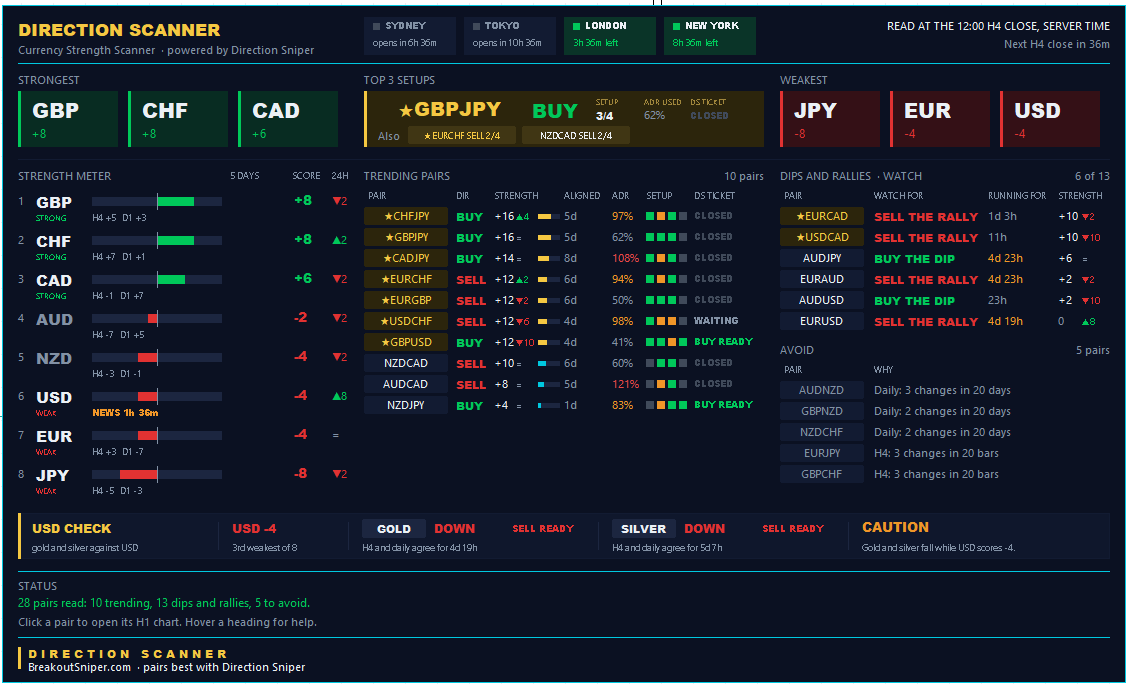
A currency is strong when it is rising against most of the other major currencies, and weak when it is falling against most of them. You find out by looking across all 28 pairs at once, not at one chart.
Here is the board from the Direction Scanner screenshot above.
| Rank | Currency | Group |
|---|---|---|
| 1 | GBP | Strongest |
| 2 | CHF | Strongest |
| 3 | CAD | Strongest |
| 4 | AUD | Middle |
| 5 | NZD | Middle |
| 6 | USD | Weakest |
| 7 | EUR | Weakest |
| 8 | JPY | Weakest |
The strength meter also shows how each currency reads on the 4 hour and the daily, because those are the two charts that decide direction on every pair. That is the same rule the Direction Sniper panel uses for its verdict.
2. The Three Pairings, Side By Side
Every pair on the board falls into one of three groups.
| Pairing | Example from the board | What usually happens | What to do |
|---|---|---|---|
| Strong vs weak | GBPJPY (strongest against weakest) | Both currencies push the same way, so the pair trends | Trade it in the direction of the strong currency, once the panel agrees |
| Strong vs strong | GBPCHF (two of the strongest) | Both currencies rise together, so the pair goes sideways | Avoid |
| Weak vs weak | EURJPY (two of the weakest) | Both currencies fall together, so the pair chops | Avoid |
Pairs that set a middle currency against another middle currency, like AUDNZD, behave like the second and third rows. There is no clear pull in either direction.
3. Pair A Strong Currency Against A Weak One
Take the three strongest currencies and the three weakest and match them up. Three times three gives nine strong vs weak pairs out of 28.
On this board, those nine are GBPJPY, CHFJPY, CADJPY, GBPUSD, USDCHF, USDCAD, EURGBP, EURCHF and EURCAD.
Now look at where the Direction Scanner placed them.
| Scanner group | Strong vs weak pairs in it |
|---|---|
| Trending | GBPJPY, CHFJPY, CADJPY, GBPUSD, USDCHF, EURGBP, EURCHF (7 of 9) |
| Dips and Rallies | EURCAD, USDCAD (2 of 9) |
| Avoid | None |
All nine strong vs weak pairs were either trending or in a pullback inside a trend. Not one was on the Avoid list. That is the whole idea of currency strength in one table.
And the reverse holds too. Every pair on the Avoid list set currencies of similar strength against each other.
4. Strong vs Weak On The Chart: GBPJPY
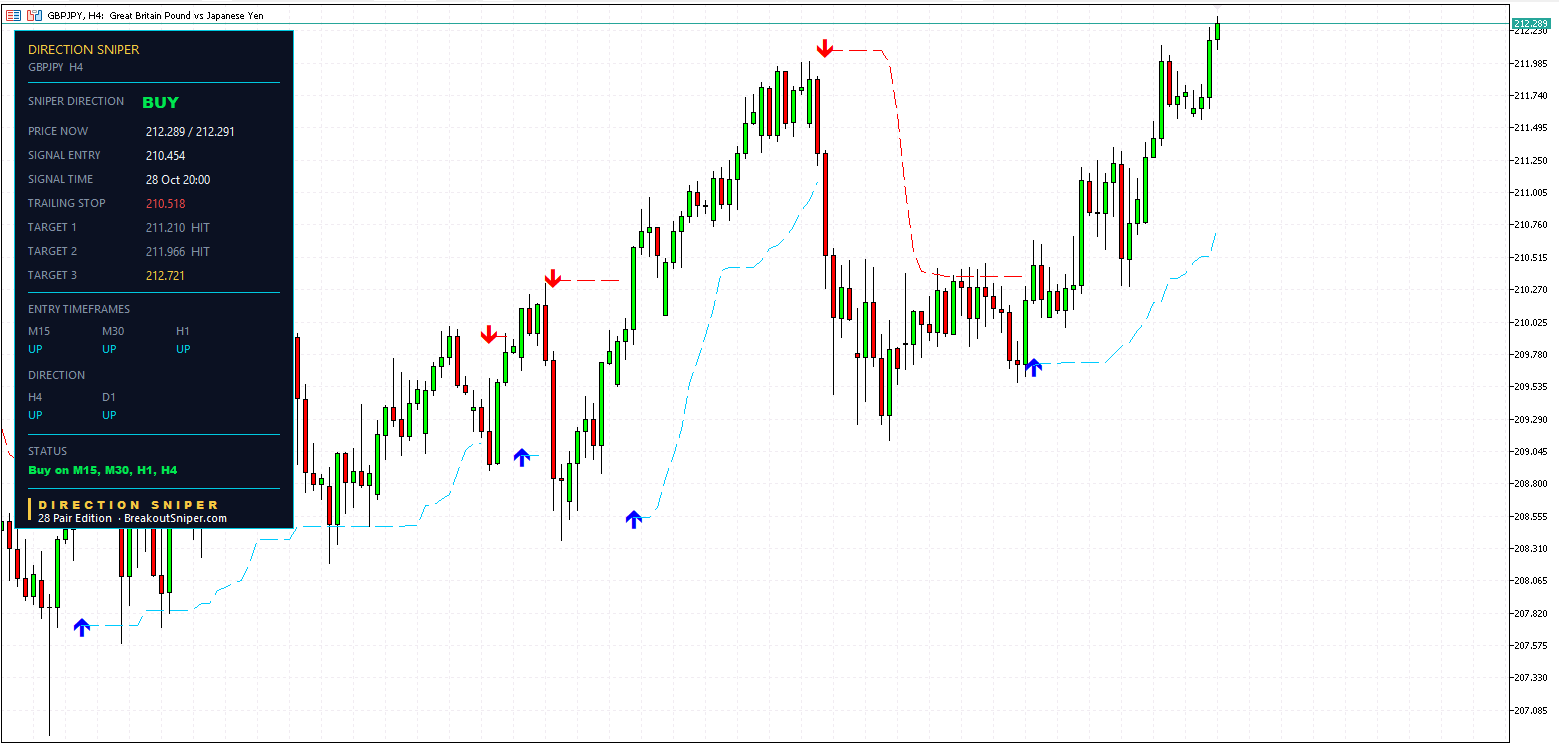
GBPJPY is the cleanest pairing on the board: the strongest currency against the weakest. The scanner ranked it as its top setup, and the 4 hour chart shows why.
Every timeframe on the Direction Sniper panel reads UP, from the 15 minute to the daily, and the status line reads Buy on M15, M30, H1, H4. On the chart, each pullback has held above the one before it, and the trailing line steps up underneath price.
| Ticket (H4) | Level |
|---|---|
| Entry | 210.454 |
| Target 1 | 211.210, reached |
| Target 2 | 211.966, reached |
| Target 3 | 212.721, open |
| Trailing stop level | 210.518, 6.4 pips in front of entry |
The ticket risked 75.6 pips to Target 1. Price is now about 183 pips above the entry, and the trailing stop level shown on the panel sits in front of entry, so the 4 hour ticket can no longer close at a loss if the trader moves their stop to it.
One note on reading the scanner: its ticket column reads the 1 hour ticket. On GBPJPY the 1 hour ticket had already closed at the moment of the screenshot, while the 4 hour ticket above was still running. Same pair, same direction, two different entry charts.
That is what strong against weak looks like: the pound pulling up, the yen letting go, and the pair moving steadily in one direction.
5. Weak vs Weak: Why EURJPY Went Nowhere
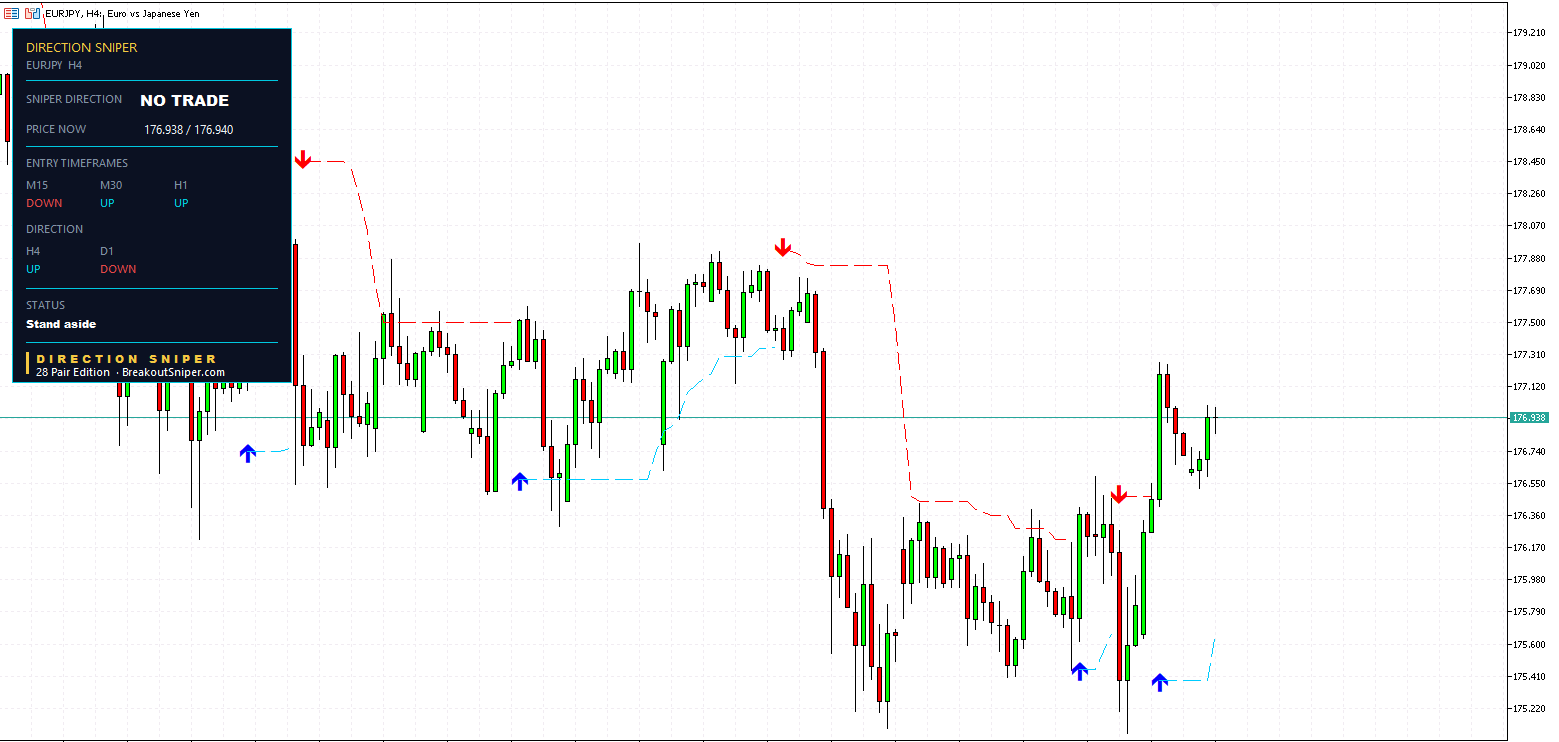
Now the opposite. EURJPY sets the euro, one of the weakest currencies, against the yen, the weakest of all. Both sides of the rope are letting go at once.
On the 4 hour chart, it looks exciting. After weeks of drifting lower, EURJPY has broken upward off its lows, a buy arrow has printed, and the trailing line has turned up under price. A trader watching only this chart would call it a breakout.
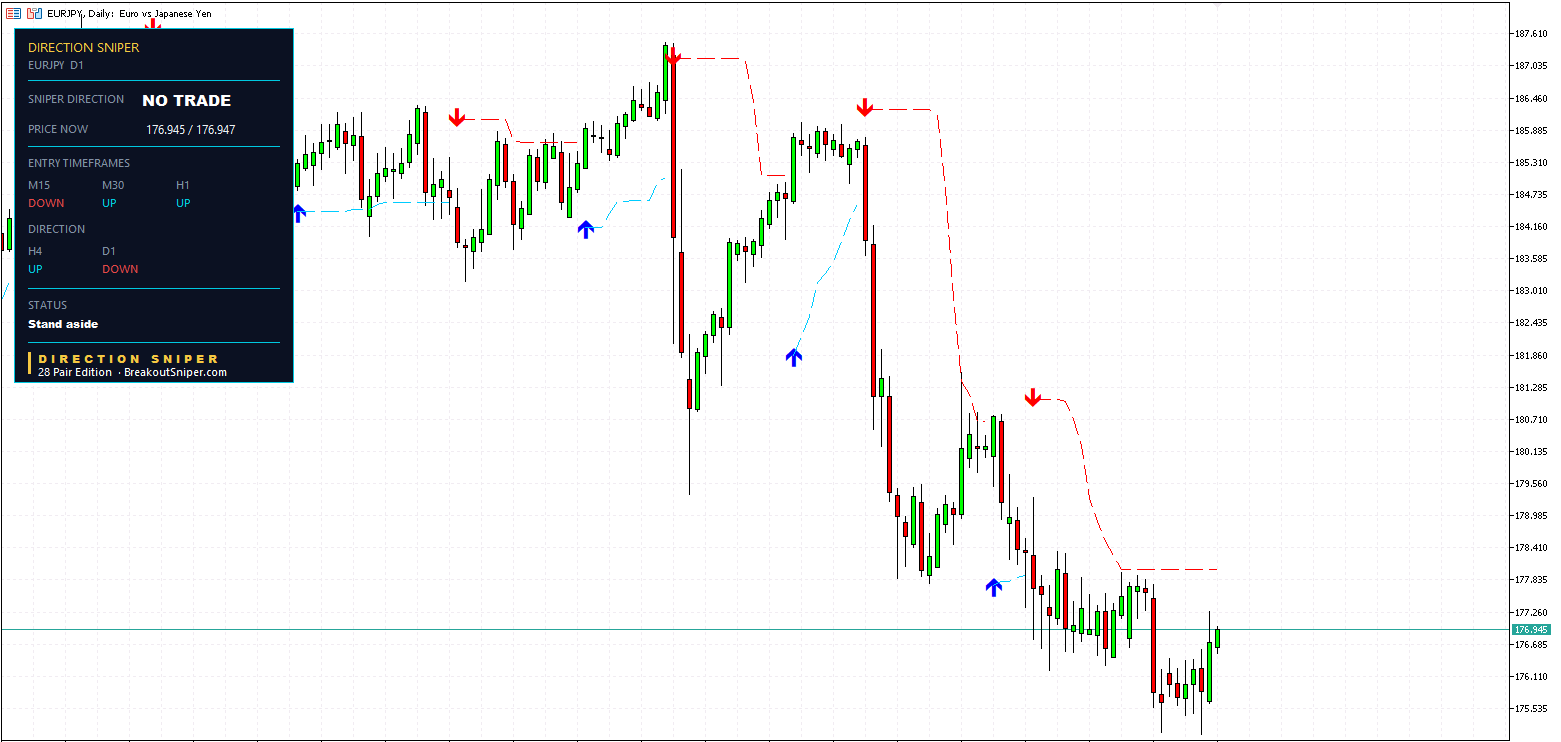
The daily chart tells a different story. EURJPY has been falling for weeks, from above 187 to around 175, and every rally has stopped below the one before it. The latest bounce has not changed that yet.
| Chart | Reads |
|---|---|
| M15 | DOWN |
| M30 | UP |
| H1 | UP |
| H4 | UP |
| Daily | DOWN |
The 4 hour and the daily disagree, so the panel shows NO TRADE and the status reads Stand aside. The Direction Scanner reaches the same conclusion from the other side: it lists EURJPY under Avoid, with the reason “H4: 3 changes in 20 bars.”
This is what weak against weak usually looks like. Neither currency has the strength to carry the pair, so it swings back and forth, and every move looks like the start of a trend until the next one cancels it. The H4 breakout may turn into something, or it may be another bounce inside the falling daily. Until the 4 hour and the daily agree, there is no trade to take.
Standing aside here is not a missed opportunity. It is what keeps your account ready for pairs like GBPJPY.
6. Strong vs Strong: Why GBPCHF Sat On The Avoid List
The same thing happens at the top of the board. The pound and the Swiss franc were the two strongest currencies, with identical strength readings. Put them in one pair and both sides pull equally hard.
The result: GBPCHF sat on the Avoid list too, again with the reason “H4: 3 changes in 20 bars.” Two strong currencies cancel each other out just as surely as two weak ones.
That is why a strength ranking is not a list of currencies to buy. It is a list of pairings to choose from. The strongest currency on the board is only worth trading against one of the weakest.
7. Strong vs Weak Is Not Always A Trade Right Now
Being strong against weak gets a pair onto your shortlist. It does not mean you enter this minute.
Two of the nine pairs, EURCAD and USDCAD, sat in the scanner’s Dips and Rallies group, marked SELL THE RALLY. The daily was trending in favour of the Canadian dollar, but the 4 hour had bounced against it. The pairing was right, the timing was not there yet.
The rule is simple. On a strong vs weak pair in Dips and Rallies, wait for the 4 hour to turn back in the direction of the trend, then wait for the panel to print a ticket. We walk through that full process in our guide on how to trade currency strength.
8. Strength Changes, So The Pairs Change Too
Look at the Avoid list once more. GBPNZD and NZDCHF are both on it, with the reason “Daily: 2 changes in 20 days.”
Both of those pairs were textbook trends in our guide to the best trending forex pairs, when the New Zealand dollar sat among the weakest currencies. On this board, the kiwi has moved into the middle, and the trends on both pairs have stalled.
Nothing changed about GBPNZD or NZDCHF. Something changed about the New Zealand dollar. That is why we read the board every trading day on our Currency Strength Today page, rather than relying on a fixed list of “trending pairs.”
9. One Weak Currency, Many Pairs: Watch Your Size
When one currency is the weakest on the board, it shows up in a lot of strong vs weak pairs. On this board, four of the ten trending pairs had the yen on the weak side: GBPJPY, CHFJPY, CADJPY and NZDJPY.
Four tickets on four charts look like four trades. They are really one bet that the yen stays weak, repeated four times. If the yen turns, all four can reach their stops together.
So we follow two rules.
- Never more than 2 positions of the same kind or in the same direction. With the yen this weak, pick the cleanest one or two yen pairs and leave the rest.
- Every position gets the same risk. We risk at most 2 percent per trade, usually 0.5 percent. Each pair has a different stop and pip value, so the lot size changes while the risk stays the same. Work it out in seconds with our free forex lot size calculator.
On a small account, a cent account makes sizes like that possible. For small balances we recommend a RoboForex Cent account or an XM Micro account. These are partner links, so we may receive a commission at no cost to you.
No single trade should ever make or break you.
10. The Strong vs Weak Checklist
- Which three currencies are strongest, and which three are weakest?
- Which of the nine strong vs weak pairs are trending, and which are in a dip or rally?
- On the pair you choose, does the Direction Sniper panel agree on every timeframe? If it says NO TRADE, wait.
- Am I already holding 2 positions on the same currency? If yes, stop there.
- Is the lot size set from the stop, at 0.5 percent risk?
Choose The Pairing, Then Let The Panel Decide
Put it together.
Strong against weak tells you which pairs are worth looking at. Strong against strong and weak against weak tell you which to leave alone. The panel tells you which way, and whether every timeframe agrees. Your lot size decides how much.
That is Direction Sniper:
- Direction. One verdict from the 4 hour and the daily on every pair. GBPJPY read BUY on every timeframe, while EURJPY read NO TRADE, so the right call on each was clear in seconds.
- Bounces that are not reversals. The EURJPY breakout on the 4 hour did not flip the call, because the daily never turned. A bounce on a weak vs weak pair stays a bounce until the bigger charts agree.
- The stop loss. Every ticket arrives with its entry, stop and three targets marked. The panel then calculates and displays the trailing stop level as the trade develops, and you move your own stop to match it. On GBPJPY, that level already sits in front of entry.
The 28 Pair Edition puts this panel on all 28 pairs, MT4 or MT5, on one licence, so you can open any strong vs weak pair on the board and see its verdict straight away.
Want the strongest and weakest currencies in your inbox every trading day? Get the free Currency Strength Scanner newsletter.
More guides on reading direction, managing trades and sizing positions: Trading Guides.
Strong vs Weak Currency Pairs: Frequently Asked Questions
1What are strong vs weak currency pairs?+
Strong vs weak currency pairs set one of the strongest currencies against one of the weakest. Because both currencies push the same way, these pairs tend to trend cleanly.
Match the three strongest currencies with the three weakest and you get nine strong vs weak pairs out of 28.
2Why does pairing a strong currency with a weak one work?+
A forex pair is a tug of war between two currencies. When one is rising against most others and the other is falling against most others, both sides pull the pair in the same direction.
On one Direction Scanner board, all nine strong vs weak pairs were either trending or in a pullback inside a trend, and none were on the Avoid list.
3What happens when you trade weak vs weak currency pairs?+
Weak vs weak pairs usually chop, because neither currency has the strength to carry the pair. EURJPY, the euro against the yen, broke out on the 4 hour chart while the daily kept falling.
The Direction Sniper panel showed NO TRADE and the Direction Scanner listed EURJPY under Avoid.
4Should I trade two strong currencies against each other?+
Usually not. Two strong currencies rise together and cancel each other out. With the pound and the Swiss franc at identical strength, GBPCHF sat on the Avoid list.
A strength ranking is a list of pairings to choose from, not a list of currencies to buy.
5Is every strong vs weak pair a trade right now?+
No. A strong vs weak pair can be in a pullback, where the daily is trending but the 4 hour has turned against it. The scanner marks these as BUY THE DIP or SELL THE RALLY.
Wait for the 4 hour to turn back with the trend and for the panel to print a ticket before acting.
6Why did a pair stop trending when nothing changed on its chart?+
Because one of its currencies changed strength. GBPNZD and NZDCHF trended while the New Zealand dollar was among the weakest, then stalled once it moved into the middle of the board.
That is why the strongest and weakest currencies need checking every trading day.
7Can I trade every pair with the weakest currency in it?+
Not all at once. When the yen is weakest, several trending pairs can share it, so four yen tickets are really one bet repeated four times. We never take more than 2 positions of the same kind or in the same direction.
We risk at most 2 percent per trade, usually 0.5 percent. These figures are for illustration, not a recommendation about how much anyone should trade.
8How does Direction Sniper help with strong vs weak pairs?+
Currency strength tells you which pairs to look at. The Direction Sniper panel then shows one verdict from the 4 hour and the daily, whether every timeframe agrees, and a ticket with entry, stop and three targets.
On the strong vs weak pair GBPJPY it read BUY on every timeframe, while on the weak vs weak pair EURJPY it read NO TRADE.
DIRECTION SNIPER 28 PAIR EDITION
Open any strong vs weak pair and see its verdict straight away.
BUY, SELL or NO TRADE on all 28 pairs, with entry, stop and three targets on every ticket. MT4 or MT5, one licence.
Disclaimer: This guide explains how we read currency strength and the Direction Sniper panel. It is educational content, not financial advice and not a trade signal service. The Direction Scanner board and the GBPJPY and EURJPY charts show what our tools displayed when the screenshots were taken, and are not a forecast or a trade recommendation. Price reaching a published target level is not the same as a realised result. Pip values and lot sizes depend on the pair, the exchange rate and your broker, and are not a recommendation about how much anyone should trade. Forex trading carries risk, and you should only trade money you can afford to lose.