How To Stop Blowing Up Your Trading Account For Good: The 0.5% Rule
Blowing up your trading account feels like a strategy problem. It almost never is.
We know, because it is the most common email we get. A trader writes in, angry and embarrassed, with an empty account and a question: “What is wrong with my strategy?” And when we ask how much they risked on each trade, the answer is nearly always the same. They never worked it out.
So we did the maths. We simulated 20,000 traders for every combination of strategy and risk, 200 trades each. The result is the single most important table in trading, and it fits on one screen.
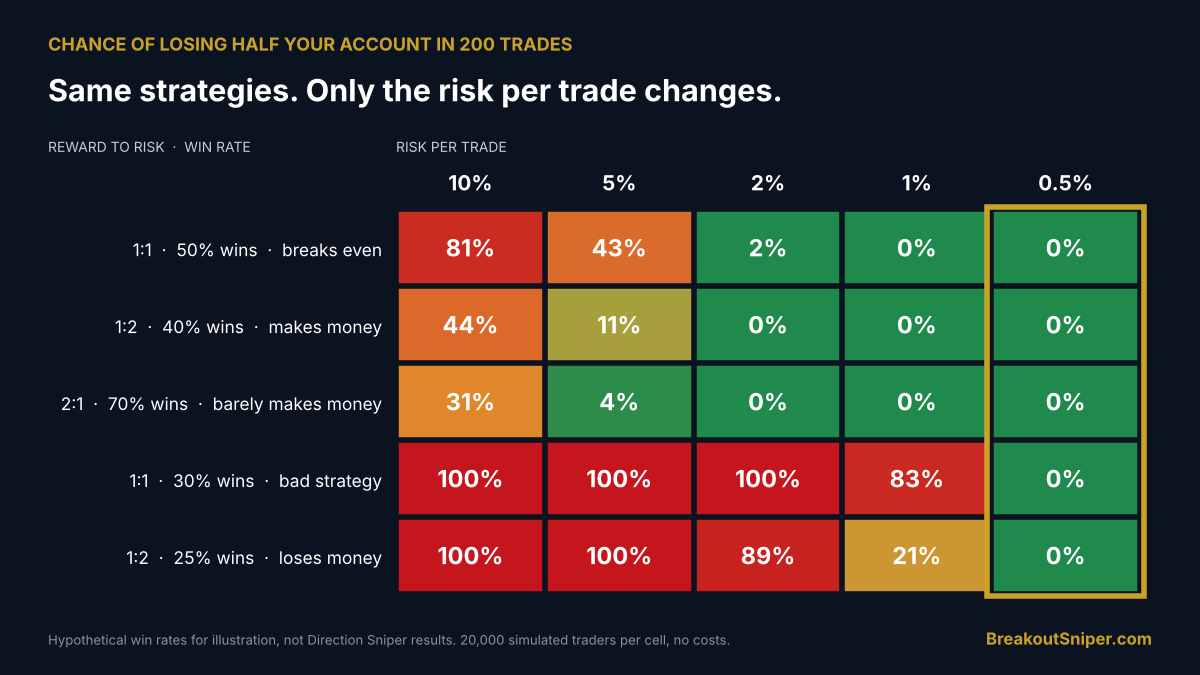
Read down the last column. Every strategy, good, bad and terrible, survives at 0.5 percent risk per trade. Read across the first column, and even strategies that make money get wrecked at 10 percent.
The strategy is the car. Your risk per trade is the fuel. You can drive the best car ever built across the desert and still run dry in the middle of nowhere. This guide is about carrying enough fuel.
The One Rule
Risk 0.5 percent of your account per trade.
Not your strategy. Not your indicator, your win rate, your broker, your timeframe or your mindset. Every one of those matters, but none of them matters until this one is right, because none of them can help a trader who is no longer in the game. Get this one number right and every other trading problem becomes fixable. Get it wrong and nothing else you do will matter for long.
We will say it louder than anyone in the trading world: 0.5 percent per trade is the most important number in your trading. It comes first, before everything else.
1. First, What Reward To Risk Actually Means
Before the tables, one idea you need: reward to risk. It compares what a trade can make with what it can lose.
1:1 is a coin flip with a friend. You bet a coffee that it lands heads. Win and you get a coffee, lose and you buy one. Risk $50 to make $50. To come out ahead, you need to be right more than half the time.
1:2 is a fisherman. He loses a bit of bait on most casts. But every so often he lands a big fish that pays for all the bait and more. Risk $50 to make $100. You can be wrong more often than you are right and still come out ahead.
2:1 is picking up coins in front of a steamroller. You win often, and every win is small. Then one loss flattens two wins at once. Risk $100 to make $50. It feels safe, right up until the steamroller arrives.
| Reward to risk | You risk | You can make | Win rate needed just to break even |
|---|---|---|---|
| 1:1 | $50 | $50 | 50% |
| 1:2 | $50 | $100 | 33% |
| 2:1 | $100 | $50 | 67% |
Now let us put each of these through the desert.
2. The One Table That Explains Every Blown Account
Here is the summary. Each row is a different strategy. The only thing that changes across the row is how much of the account each trade risks.
Chance of losing half your account within 200 trades
| Strategy | At 10% risk | At 0.5% risk |
|---|---|---|
| 1:1, 50% wins (breaks even) | 81% | 0% |
| 1:2, 40% wins (makes money) | 44% | 0% |
| 2:1, 70% wins (barely makes money) | 31% | 0% |
| 1:1, 30% wins (a bad strategy) | 100% | 0% |
| 1:2, 25% wins (loses money) | 100% | 0% |
Look at the second row. That strategy makes money over time. At 10 percent risk, it still loses half the account 44 percent of the time.
Now look at the fourth row. That strategy is genuinely bad. At 0.5 percent risk, it never lost half the account in 200 trades.
A good strategy cannot save a big lot size. A small lot size can save a bad strategy, long enough for you to fix it. That is the whole article. The rest is the proof.
3. The Coin Flip: 1:1 Reward To Risk
Chance of losing half your account within 200 trades, at 1:1
| Win rate | Risk 10% | Risk 5% | Risk 2% | Risk 1% | Risk 0.5% |
|---|---|---|---|---|---|
| 50% (breaks even) | 81% | 43% | 2% | 0% | 0% |
| 40% (loses money) | 100% | 99% | 76% | 2% | 0% |
| 30% (a bad strategy) | 100% | 100% | 100% | 83% | 0% |
A 50 percent coin flip should leave you exactly where you started. At 10 percent risk, it halves the account 81 percent of the time anyway.
Why? Because losses hurt more than wins help. Lose 10 percent and you need 11 percent just to get back. Lose half the account and you need to double it. The bigger the bites, the faster the hole gets deeper than you can climb out of.
At 0.5 percent, the bites are so small the hole never gets deep.
4. The Fisherman: 1:2 Reward To Risk
Chance of losing half your account within 200 trades, at 1:2
| Win rate | Risk 10% | Risk 5% | Risk 2% | Risk 1% | Risk 0.5% |
|---|---|---|---|---|---|
| 50% (makes money) | 5% | 0% | 0% | 0% | 0% |
| 40% (makes money) | 44% | 11% | 0% | 0% | 0% |
| 30% (just below break even) | 99% | 90% | 37% | 1% | 0% |
| 25% (loses money) | 100% | 100% | 89% | 21% | 0% |
This is the table that should worry anyone who thinks a good strategy is enough.
A fisherman who lands a big fish 40 percent of the time makes money. But risk 10 percent on every cast and he loses half his boat 44 percent of the time anyway. Along the way, his typical worst fall from a high point is 79 percent of the account. At 0.5 percent, the same fisherman’s typical worst fall is 6 percent.
Most traders would quit long before a 79 percent fall. Nobody quits over 6 percent.
5. The Steamroller: 2:1 Reward To Risk, The High Win Rate Trap
Chance of losing half your account within 200 trades, at 2:1
| Win rate | Risk 10% | Risk 5% | Risk 2% | Risk 1% | Risk 0.5% |
|---|---|---|---|---|---|
| 80% (makes money) | 0% | 0% | 0% | 0% | 0% |
| 70% (barely makes money) | 31% | 4% | 0% | 0% | 0% |
| 60% (loses money) | 99% | 86% | 12% | 0% | 0% |
| 50% (loses money) | 100% | 100% | 96% | 4% | 0% |
Here is the trap. A 60 percent win rate sounds wonderful. At 2:1, it is a losing strategy. You win six coins out of ten, and the steamroller takes back eight.
Traders who chase a high win rate often end up exactly here: small targets, wide stops, lots of little wins, and a feeling of safety. At 10 percent risk, that feeling ends with the account halved 99 percent of the time.
At 0.5 percent, even the 50 percent row survives 200 trades. The steamroller still arrives, but it only ever catches the tip of your shoe.
6. The Bad Road Every Driver Hits
Every strategy has losing streaks. Not maybe. Always. Here is how long they get in 200 trades.
| Win rate | Typical longest losing streak | 1 trader in 10 sees | What that streak costs at 10% risk | At 0.5% risk |
|---|---|---|---|---|
| 50% | 7 in a row | 9 | 52% of the account | 3% |
| 40% | 9 in a row | 12 | 61% of the account | 4% |
| 30% | 12 in a row | 17 | 72% of the account | 6% |
Twelve losses in a row sounds like a disaster. It is a normal stretch of bad road for a strategy that wins 30 percent of the time.
At 10 percent risk, that stretch costs 72 percent of the tank. At 0.5 percent, it costs 6 percent. Same road. One driver is stranded, the other has a bad week.
The question is never whether you will hit the bad road. It is whether you will still have fuel when it ends. Nothing on your chart decides that. Only the size does.
7. Why Most Traders Think Their Account Blew Up
Ask a trader why their account blew up and you almost never hear “I risked too much.” You hear a story. We read these stories in our inbox every week, and they come in a few familiar shapes.
| What the trader says | What usually happened |
|---|---|
| “The market was rigged against me” | Normal price movement met a position too big to survive it |
| “My broker hunted my stop” | Price touched a level it touches every week. At small size it would have been a scratch |
| “One news spike wiped me out” | One news spike can only wipe out an account that bet most of itself on one trade |
| “I was just unlucky” | A normal losing streak, the bad road every strategy hits, met too little fuel |
| “My strategy stopped working” | The strategy did what it always does: lost a few in a row. The size turned a dip into a disaster |
| “I need a better entry” | A better entry changes where the trade starts, not how much it can take |
| “I’m just not disciplined enough” | Discipline breaks under weight. Big size makes every candle feel like an emergency |
Every one of these is a real event. None of them is the reason.
The Last Drop Gets The Blame
Here is why the stories feel so true. Traders blame the trade that finished the account, not the size that set it up.
Picture a glass of water filled to the brim. One more drop and it overflows. Nobody blames the glass size; everyone blames the last drop. In trading, the last drop is the news spike, the stop hunt or the bad Friday. It is vivid, it hurts, and it is easy to remember. The size that filled the glass to the brim, trade after trade, is quiet and invisible.
A trader at 10 percent risk is always one or two bad drops from the edge. When the edge finally arrives, the last drop gets the blame.
Why The Stories Feel So Convincing
- It is easier to blame something outside you. “The broker did it” hurts less than “I chose that lot size.”
- The last trade is the loudest memory. The quiet decision to risk 10 percent was made weeks ago and never felt like a decision at all.
- Each story comes with a fix to buy. A new strategy, a new indicator, a new broker. Buying something feels like progress. Making the size smaller feels like going backwards.
- Nobody did the maths. Most traders have never seen the tables above, so they have no reason to suspect the size.
That is why so many traders blow up a second and a third account. They fix the story, keep the size, and walk straight back to the edge of the glass.
The fix starts with one honest question after every bad trade: “How much did that trade risk?” Not what went wrong with the market. How much was on the line.
8. Debunked: Everything Else They Blame
Then come the experts. Search “why did I blow up my account” and you will get a long list of suspects. Every one of them is real. None of them is the cause. They are the trigger. The cause is the size.
| What the experts blame | Why it is not the real cause |
|---|---|
| Your strategy | The tables above: a 30% strategy survives at 0.5% risk. A winning one dies at 10% |
| A low win rate | Same tables. Win rate decides how fast you grow, not whether you survive |
| Too much leverage or margin | Leverage is a bigger engine, not more fuel. It allows a big position. Your lot size is what makes it big |
| No stop loss | A stop with 10% of the account behind it still empties the tank in a few trades |
| Fear and greed | Emotions are the dashboard warning light, not the engine fault. If you panic, the lot size is too big |
| Revenge trading | Only deadly when each trade carries big risk. Ten angry trades at 0.5% cost 5% |
| Overtrading | 20 trades at 0.5% puts 10% at risk. 20 trades at 5% puts the whole account at risk |
| Broker stop hunts and spread spikes | A spike at 0.5% risk is a scratch. At 10% it is the end of the account |
| News and volatility | Same story. Small size turns a storm into a bumpy ride |
| The wrong timeframe or indicator | These change how often you win, not how much each loss takes |
| Too small an account | A small account forces big percentages. There are four ways around it (see below) |
Fixing the trigger feels productive. Traders swap strategies, buy indicators, change timeframes and change brokers, and blow up again. The experts keep selling better cars. Nobody tells you to check the fuel.
Fix the size first. Then, and only then, the rest is worth fixing.
9. The Fix: The One Rule That Comes First
We risk at most 2 percent per trade, usually 0.5 percent. Here is how to do it on every trade, in four steps.
- Decide the risk in dollars. 0.5 percent of a $1,000 account is $5. Of a $10,000 account, $50.
- Find the stop before you enter. Where is the trade wrong? Measure the distance from entry to stop.
- Work out the lot size from the stop. On EURUSD, one standard lot moves $10 per pip. A $5 risk with a 25 pip stop is $5 / (25 x $10) = 0.02 lots.
- Round down, never up.
Do it in seconds with our free lot size calculator. It covers gold, silver, all 28 forex pairs, Bitcoin and Ethereum. For a full walkthrough on gold, read how to calculate lot size for gold.
Two more rules that protect the tank:
- Never more than 2 positions of the same kind or in the same direction. Four trades that all depend on the same currency are one bet with four times the size. We explain why in strong vs weak currency pairs.
- The panic test. If your heart races every time price moves, you are carrying too little fuel for the trip you chose. Make the size smaller until you can watch price move toward your stop and feel nothing much at all.
10. “My Account Is Too Small For 0.5%”
This is the most common reason traders give up on the rule before they start. On a small account, 0.5 percent is tiny, and the smallest trade a standard account allows is often bigger than that.
Here is what happens on a $100 standard account, where the smallest trade is 0.01 lots.
| Market | Stop distance | Risk with the smallest trade (0.01 lots) | As a share of $100 |
|---|---|---|---|
| EURUSD | 25 pips | $2.50 | 2.5% |
| Gold | $5 | $5 | 5% |
| Gold | $10 | $10 | 10% |
Your 0.5 percent target is 50 cents. The smallest trade the account allows is five to twenty times that. Nobody chose to risk 10 percent. The account size chose it for them. That is how small accounts get pushed straight into the red side of the heat map without anyone noticing.
It is like being told to carry 50 cents’ worth of fuel, at a petrol station that only sells full tanks. The answer is not to buy the full tank anyway. It is to find a smaller pump.
Here are the four ways to keep the rule on a small account.
1. Use A Cent Account
A cent account shows your balance in cents, so $100 appears as 10,000 cents, and the smallest trade is a tiny fraction of the smallest standard trade. Check the exact contract size in your platform, because it differs between brokers. The 0.5 percent rule then works exactly the same: same stop, same calculator, much smaller position.
Think of it as a smaller car to learn to drive in, on the same roads, with the same rules.
For small balances we recommend a RoboForex Cent account or an XM Micro account. These are partner links, so we may receive a commission at no cost to you.
2. Choose Entry Charts With Smaller Stops
A 4 hour ticket on gold might carry a $20 stop. A 15 minute ticket in the same direction might carry $4. Same direction, very different risk.
On a small account, the faster entry charts are often the only ones where the smallest trade fits inside 0.5 percent. Never shrink a stop just to make the size fit, though. Use the stop the chart gives you, and pick the chart whose stop your account can carry.
3. If The Smallest Trade Is Still Too Big, Skip It
Sometimes even the smallest position risks more than your limit. Then the answer is simple: no trade.
This is the hardest rule for small accounts, and the most important. Skipping a trade costs nothing. Taking one at 5 or 10 percent risk is how the account ends up empty. There will always be another ticket with a stop your account can carry.
4. Grow The Account By Adding Money, Not By Raising Risk
The quickest way to make a small account bigger feels like risking more. It is actually the quickest way to make it zero. Prove the method at 0.5 percent first, then add money to the account when you can. The habit you build on $100 is exactly the habit that protects $10,000 later.
“It is only $100, so the rules do not matter” is the most expensive sentence in trading. The size of the account changes. The habits you build on it do not.
11. “But I Only Make So Little Per Trade”
This is the first thing every trader says about the 0.5 percent rule. It is a fair question, and it deserves a straight answer.
Yes, each trade makes less. That is the point. A trade that can make a lot can also take a lot. You cannot have the first without the second. The urge to make more per trade is the exact urge that emptied the account last time.
Here is how traders who last think about it.
- The hare and the tortoise. The hare sprints, makes great time, and falls asleep in a ditch. The tortoise keeps walking. In trading, the hare’s ditch is the bottom of the table above, and plenty of hares never wake up from it.
- The number of trades is the real multiplier. One trader risks 10 percent and may not survive the first bad stretch of road. Another risks 0.5 percent and is still trading a year later, with every lesson those trades taught. Skill is built over hundreds of trades, not ten.
- Grow the account, not the risk. 0.5 percent of $1,000 is $5. 0.5 percent of $50,000 is $250. Same rule, same calm, bigger dollars. Prove the method on a small account first, then add capital once the results earn it. Never get bigger by risking more per trade.
- Calm traders make better decisions. At 0.5 percent, a loss is a cost of doing business, not a crisis. You stop moving stops, closing good trades early and revenge trading. That alone can change your results more than any new strategy.
Over the years, we went from aggressive trading to sustainable growth and strong defence. The motto we keep coming back to is simple: no single trade should ever make or break you.
12. Does This Mean You Trade At 0.5% Forever?
No. 0.5 percent is where you start, not where you have to stay. Think of it as a learner’s permit. Nobody gives a new driver the keys to a race car on day one, but nobody makes them drive at 30 kilometres an hour for the rest of their life either.
You earn the right to drive faster. Here is the ladder, and the hard limit at the top of it.
| Step | Risk per trade | What you need before you step up | What a 12 loss streak costs |
|---|---|---|---|
| 1. Learner | 0.5% | Every new trader, every new strategy, every new account | 6% |
| 2. Proven | 1% | A journal of at least 100 trades at 0.5% showing your approach has a real statistical edge, with the rules followed on every trade | 11% |
| 3. Consistent | 1.5% | Several months of steady results at 1%, and no broken rules after losing streaks | 17% |
| 4. The ceiling | 2% | A sound strategy, a long record of consistency, and proven emotional control | 22% |
Never above 2 percent. Even the best traders hit the bad road. At 2 percent, the 12 loss streak in the last column costs about a fifth of the account. Above that, it starts to cost the account.
And the ladder runs the other way too. The bigger the account, the smaller the percentage tends to get: 0.5 percent of a large account is already plenty of money on the line.
The Real Test Is Not Your Strategy. It Is You.
Most traders think the ladder is about proving the strategy. The strategy is the easy part. The real question is whether you can stay the same person after five losses in a row.
A strategy with an edge only works if you take every trade it gives you, exactly the same way, win or lose. The moment emotion takes the wheel, the edge disappears, and a bigger risk per trade only makes the crash faster.
So before you climb a step, be honest with yourself. You are ready when:
- You take the next trade after a losing streak without hesitating, and without making it bigger to win it back.
- You never move a stop further away because you hope price will turn.
- You never close a good trade early because you are scared of giving the gain back.
- You sleep normally with trades open. If you check your phone at 3am, you are not ready for the next step.
- You feel roughly the same after a win and after a loss. Big highs and big lows are a sign the size is still too heavy for you.
- Your journal shows the rules followed on every trade, not just most of them.
If even one of these is not true yet, stay where you are. There is no prize for climbing early.
Step Back Down When The Road Gets Rough
Climbing the ladder is not permanent. Step back down a level when:
- A losing streak shakes you. If you notice yourself hesitating, chasing or doubling up, go back down until the calm returns.
- The account falls about 10 percent from its high. Smaller steps until it recovers.
- Life gets stressful. Tired, worried or distracted traders make the same mistakes as greedy ones. Trade smaller on those weeks.
- You change strategy, market or account. Anything new starts back at 0.5 percent.
Think of it like driving in the rain. A good driver does not prove anything by keeping the same speed in a storm. They slow down, arrive safely, and speed up again when the road dries.
Trading feels stress free at the right size. If it does not feel that way, the size is wrong, however good the strategy is.
13. Just Blew Your Account? Do This Next
If you are reading this with an empty account, here is the way back.
- Stop for one week. No trading. The urge to win it back fast is the most expensive feeling in trading.
- Write down what each trade risked. Not what the strategy was. What percentage of the account each trade put on the line. You will probably find the answer right there.
- Open a cent account and fund it with an amount you could lose without it hurting.
- Trade 100 trades at 0.5 percent. Same rules every time, lot size from the stop, no exceptions.
- Keep a simple journal. Entry, stop, size, result, and how calm you felt.
- Add money only once the 100 trades prove the method. The first goal is not to make money. It is to become a trader who cannot be knocked out.
The Whole Guide In One Line
Your strategy decides how fast you grow. Your risk per trade decides whether you survive. And you cannot grow if you do not survive.
That is why we put one number above everything else in trading, and why we will keep saying it louder than anyone: 0.5 percent per trade. Carry enough fuel and the desert cannot beat you.
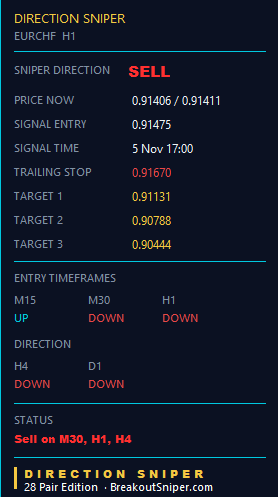
A good direction tool helps the car drive straight. That is what Direction Sniper does:
- Direction. One verdict from the 4 hour and the daily on every pair, so you are not trading against the bigger trend.
- Bounces that are not reversals. When the fast charts swing against the trend, the verdict holds, so a bounce does not tempt you into a bad trade.
- The stop loss. Every ticket arrives with its entry, stop and three targets marked, so your stop distance, and your 0.5 percent lot size, are known before the trade exists. The panel then calculates and displays the trailing stop level as the trade develops, and you move your own stop to match it.
Want to see the 0.5 percent rule applied to real tickets every trading day? Get the free Currency Strength Scanner newsletter.
More guides on reading direction, managing trades and sizing positions: Trading Guides.
How we ran the numbers: 20,000 simulated traders for every combination of win rate, reward to risk and risk per trade, 200 trades each, each trade risking a fixed percentage of the current balance. The win rates are hypothetical, chosen to illustrate the maths, and are not the results of Direction Sniper or any other tool. The simulation leaves out spread, commission, slippage and price gaps, which make real results worse, and a gap can move price past a stop loss. That is why we say 0.5 percent risk makes blowing up your account next to impossible, not impossible.
Blowing Up Your Trading Account: Frequently Asked Questions
1What is the main reason traders blow up their trading account?+
Risking too much on each trade. In our simulation of 20,000 traders per setup, even a strategy that makes money lost half the account 44 percent of the time at 10 percent risk per trade.
At 0.5 percent risk, no setup we tested lost half the account in 200 trades, including a bad strategy that won only 30 percent of the time.
2How much should I risk per trade to avoid blowing up my account?+
We risk at most 2 percent per trade, usually 0.5 percent. At 0.5 percent, a run of 12 losses in a row costs about 6 percent of the account.
These figures are for illustration, not a recommendation about how much anyone should trade.
3Should I always risk 0.5 percent per trade?+
0.5 percent is where you start. Once a journal of at least 100 trades shows your approach has a real statistical edge and you follow your rules every time, you can step up slowly to 1 percent, then 1.5 percent, then 2 percent.
Never go above 2 percent, and step back down after a losing streak shakes you or when you change strategy. Emotional control matters more than the strategy.
4What does reward to risk mean?+
Reward to risk compares what a trade can make with what it can lose. At 1:1 you risk $50 to make $50, at 1:2 you risk $50 to make $100, and at 2:1 you risk $100 to make $50.
The break even win rates are 50 percent, 33 percent and 67 percent.
5Is a high win rate enough to stop blowing up my account?+
No. At 2:1 reward to risk, a 60 percent win rate still loses money, and at 10 percent risk it halved the account 99 percent of the time in our simulation.
A high win rate with small wins and big losses can feel safe right up until it is not.
6Is leverage the reason CFD accounts blow up?+
Leverage allows a big position, but it does not choose the size. Your lot size does.
Set the lot size from your stop loss so each trade risks about 0.5 percent, and leverage no longer decides how much you can lose.
7How do I risk 0.5 percent on a small account?+
On a 100 dollar account, 0.5 percent is 50 cents, which most standard accounts cannot trade. A cent account allows much smaller positions, so the same rule works.
For small balances we recommend a RoboForex Cent account or an XM Micro account.
8Doesn’t 0.5 percent risk make too little per trade?+
Each trade makes less, and that is the point: a trade that can make a lot can also take a lot. Grow the account once your method is proven, not the risk per trade.
0.5 percent of 1,000 dollars is 5 dollars, and 0.5 percent of 50,000 dollars is 250 dollars, with the same calm.
9I just blew my trading account. What should I do next?+
Stop for a week, then write down what each trade risked. Open a cent account with money you could lose without it hurting, and trade 100 trades at 0.5 percent risk with a simple journal.
Add money only once those trades prove the method.
DIRECTION SNIPER 28 PAIR EDITION
Know your stop before you enter, so your 0.5% lot size is set before the trade exists.
One verdict on all 28 pairs, and every ticket arrives with its entry, stop loss and three targets marked. MT4 or MT5, one licence.
Disclaimer: This guide is educational content, not financial advice and not a trade signal service. Price reaching a published target level is not the same as a realised result. Pip values and lot sizes depend on the instrument, the exchange rate and your broker, and are not a recommendation about how much anyone should trade. Trading CFDs, forex and other leveraged products carries a high level of risk, and you should only trade money you can afford to lose.