Is 10% A Month Realistic In Forex? The Reality Most Traders Cannot Accept
Is 10% a month realistic? You probably already think so. It feels modest. It feels like the least a serious trader should make. And that feeling is exactly what is quietly emptying your account.
This guide will not tell you what you want to hear. It will show you the maths, put your goal next to the most famous traders who ever lived, and then show you the one honest way to make more money from trading. Stay with it to the end. It could save your account.
1. Why 10% Feels So Reasonable To You
Be honest. When you first set your goal, 10% a month sounded small.
It is a tip at a restaurant. It is a discount at a shop. On your $2,000 account, it is $200 a month, about $10 a trading day. You have probably made $10 in a single trade before. How hard can it be to do it every day?
That is the trap. The number looks tiny in dollars and enormous in compounding. And you have been looking at the dollars.
2. Let It Compound For A Year
Here is what your “small” 10% a month does to $2,000, if you really hit it every month:
| Time | Your $2,000 becomes |
|---|---|
| 12 months | about $6,300, more than 3 times the account |
| 5 years | about $609,000 |
Two thousand dollars to over half a million in five years. If that were realistic, every trader you know with a laptop would be a millionaire by now. Look around. They are not.
“But Doesn’t 10% A Month Just Double My Account In A Year?”
You are not alone in thinking that. It is one of the most asked questions on trading forums. The answer surprises almost everyone. No. Compounded, 10% a month more than triples your account in a year, about 3.1 times. Even if you withdrew every gain and never compounded, it would still be 120% a year.
Here is how a monthly goal turns into a yearly one:
| Your monthly goal | What it means per year, compounded |
|---|---|
| 1% | about 12.7% |
| 2% | about 26.8% |
| 3% | about 42.6% |
| 5% | about 79.6% |
| 10% | about 213.8% |
Famous trading records are quoted per year, so keep this table in mind. Larry Hite’s Mint Investments averaged about 30% a year. Your “reasonable” 10% a month asks for more than 200%.
The $100 Million Test
Still not convinced? Imagine someone hands you a fund with $100 million and you really can do 10% a month.
After ten years, that $100 million is worth about $9 trillion. That is bigger than the entire stock market of almost every country on earth. You would end up owning a large part of the planet.
It has never happened. Not once. If 10% a month could be kept up year after year, the people with the most money, the fastest computers and the smartest teams would already be doing it. They are not even close.
These figures are arithmetic about what a goal requires. They are not a forecast of what any trader or any tool will make.
3. Why Your Compounding Calculator Lied To You
You have probably typed 10% a month into a compounding calculator before, and smiled at the result.
A normal compounding calculator is like a car speedometer that goes up to 500 km/h. It happily shows you the number. It never tells you the engine explodes long before you get there. It never asks the only question that matters: has any trader actually kept this up?
That is why we built our free forex compounding calculator with a reality check. It shows you the dream number, and then it shows you where that number sits next to real traders.
4. Your Goal Next To The Legends
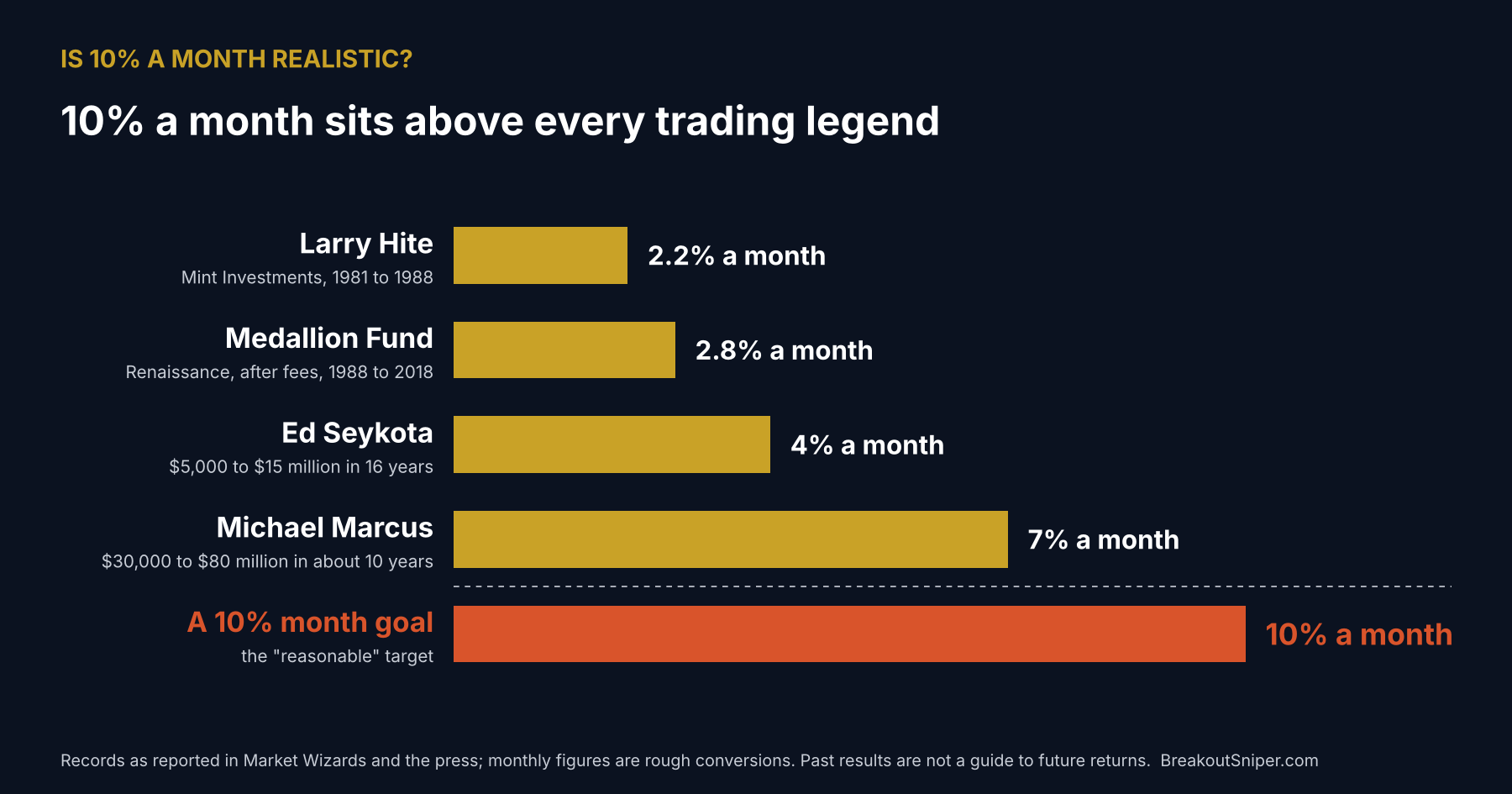
Here is what some of the most celebrated trading records in history work out to, converted to rough monthly rates:
| Benchmark | Roughly per month |
|---|---|
| Larry Hite, Mint Investments, 1981 to 1988 | about 2.2% |
| Medallion Fund, after fees, 1988 to 2018 | about 2.8% |
| Ed Seykota, $5,000 to over $15 million in 16 years | about 4% |
| Michael Marcus, $30,000 to $80 million in about 10 years | about 7% |
| Your “reasonable” 10% a month | 10% |
Read that table slowly. These are full time professionals and teams of scientists, with decades of experience, and they still had losing periods along the way. Your “small” 10% a month sits above every one of them.
Think of a marathon. The fastest runners in the world finish in just over two hours, after years of training. If you have just started running and you plan to beat that pace every week, you are not ambitious. You are heading for an injury on the first kilometre.
We tell the full story of these traders, including what happened when Richard Dennis pushed too hard, in our guide on how to grow a small forex account.
5. “But I Can Easily Make 0.5% A Day”
Maybe you are thinking it right now. We once heard it from a trader friend. We told him we had never met anyone who could make 0.5% a day, consistently, over a long period of time. He smiled and said he could do it easily.
He was not lying about what he had seen. He had probably done it for a week, maybe a month. Perhaps you have too. The problem is not the short period. The problem is the long one. Here is how that argument ends.
First, 0.5% a day is not small. Compound it over 20 trading days and it comes to about 10.5% a month. It is the same 10% a month goal, wearing a smaller number.
Second, let it run. Here is what 0.5% a day does to $10,000, with about 250 trading days a year:
| Time | $10,000 becomes |
|---|---|
| 1 month | about $11,000 |
| 1 year | about $34,800, nearly 3.5 times |
| 5 years | about $5.1 million |
| 10 years | about $2.6 billion |
So “I can easily make 0.5% a day” really means “I am on track to turn $10,000 into billions within ten years, and beat the best trading fund on record by a mile.” If that were true, the biggest funds in the world would be queuing at your door.
Third, a short streak proves very little. Flip a coin and get heads five times in a row. It happens all the time, and it says nothing about your skill. Flip heads a thousand times in a row, and the world wants to study you. A great week or a great month can come from a strong trend, a lucky run or a bigger lot. Only years of results, through good markets and bad, show real skill.
Fourth, you will have losing days. To average 0.5% a day, every losing day must be paid back by bigger winning days. And the only way to make bigger winning days on demand is a bigger lot. That is the trap again.
Finally, look at the number. We risk 0.5% per trade. He wanted to make 0.5% per day. Same number, opposite thinking. One protects your account. The other demands from it, every single day, forever.
So the honest answer is not “you can’t.” It is this: “Show me twelve months, verified, with the drawdowns included.” We are still waiting for that statement, from him and from everyone else who has said the same thing.
6. How To Check Anyone’s “10% A Month” Claim
You have seen the screenshots. In trading groups, on social media, in your own inbox. Huge monthly gains, and a little voice in your head asking, “why not me?”
Before you let one of them reset your expectations, ask five questions:
- How long is the record? One good month means very little. You want years, not weeks.
- What was the biggest drawdown? A big return with a 60% drop along the way usually means a big lot, and the next drop could be the last.
- What risk was taken per trade? If the answer is 5% or 10%, the return is not skill. It is exposure.
- Is the account verified? A screenshot can be cropped, edited or taken from a demo account. A verified, third party record is much harder to fake.
- Were deposits and withdrawals included? Adding money can make the growth look far better than the trading really was.
A real record survives all five questions. Most “10% a month” screenshots do not survive the first one.
7. “If Nobody Has Done It, Does That Mean I Can’t?”
It is a fair question. You deserve an honest answer. No, nobody can prove that you never will. Records exist to be broken.
But look at how records actually get broken.
In 1954, Roger Bannister became the first person to run a mile in under four minutes. Everyone remembers it as the day the impossible became possible. But look at the numbers. The old record was 4 minutes 1.4 seconds. Bannister ran 3 minutes 59.4 seconds. He beat it by two seconds, not by two minutes. Seventy years later, the world record is still around three minutes and forty three seconds. The greatest runners in history have only shaved a few percent off the mile.

That is how human limits move: a little at a time, at the very edge.
Now look at your goal again. A steady 10% a month is not two seconds faster than the legends. It is about two and a half times Ed Seykota’s pace and well over three times the Medallion Fund’s. That is not breaking a record. That is planning to run the mile in under two minutes.
So here is the honest truth:
- You can have a great month. Plenty of traders do. A single month of 10% or more is not impossible. Keeping it up for years is a different story.
- You can become a very good trader. Better than most. Good enough to grow an account steadily for decades. That is real, and it is within your reach.
- What you cannot do safely is size your lot as if the dream were already true. The danger is not in dreaming. It is in risking your account today on a pace nobody has ever proven.
And here is the part that should settle it for you. If you really are that exceptional, 0.5% risk per trade will not stop you. A real edge shows up at any size. It will show in your record at 0.5% just as clearly as at 10%, only without the risk of being wiped out along the way. Only a lucky streak needs a big lot.
So aim to be exceptional. Then prove it the way the legends did: small risk, a long record, and time.
8. So What Is Realistic Per Month?
Nobody can promise you any return, and many traders make less than this or lose money. But the legends give you an honest ceiling to measure yourself against.
Over many years, with losing periods along the way, the best reported records in the table above work out to roughly 2% to 4% a month. Those are full time professionals at the very top of the game.
So if you ask us what a strong month looks like as a long term average, the honest reference is somewhere around 1% to 3% a month. Even that would put you in very rare company if you kept it up for years. Treat it as a ceiling to respect, not a target to force.
Think of a well run shop. A good shop owner is happy with a steady margin on every sale, month after month. Nobody expects the shop to double its money every month, and the shops that try usually close.
9. Now Work Out What That Means For You, Per Day
Find your account size in this table. This is what that monthly range means in dollars per trading day, using 20 trading days a month:
| Account size | At 1% a month | At 2% a month | At 3% a month |
|---|---|---|---|
| $2,000 | $1 a day | $2 a day | $3 a day |
| $10,000 | $5 a day | $10 a day | $15 a day |
| $25,000 | $12.50 a day | $25 a day | $37.50 a day |
| $50,000 | $25 a day | $50 a day | $75 a day |
| $100,000 | $50 a day | $100 a day | $150 a day |
This is arithmetic on a reference range, not a forecast or a promise of any result. Real months include losing months.
If your account is $2,000, sit with this for a moment. At a pace the legends would respect, your account is a $1 to $3 a day account. Not $15. Not $50.
That may hurt to read. But look at where $15 a day actually lives: on a $10,000 account at 3% a month, or a $15,000 account at 2%. Your goal was never wrong. It was simply sitting on the wrong account size.
And that leads to the most important idea in this guide.
10. Bigger Capital, Not A Bigger Lot
The only honest way for you to make more money per day or per month is to trade with more capital. Not with a bigger lot.
Your 0.5% risk per trade stays the same at every account size. What changes is the dollar figure behind it:
| Account size | 0.5% risk per trade |
|---|---|
| $2,000 | $10 |
| $10,000 | $50 |
| $50,000 | $250 |
| $100,000 | $500 |
Same skill. Same stop. Same discipline. Same 0.5%. The only thing that grew was the capital.
Think of two water tanks with the same tap. Open the tap wider on the small tank and you do not get more water. You just empty the tank faster. A bigger tank gives you more water at the same steady flow. Your lot size is the tap. Your capital is the tank.
So how do you grow the tank?
- Deposits. Add money from your salary or business every month. It is the fastest safe way to grow a small account.
- A proven record. Keep a record of every trade. When it shows you follow your rules, you have earned the right to trade a bigger account, and to trust yourself with it.
- Funded capital. Some traders use prop firm challenges to trade a larger account. That can be a sensible step, but the rule does not change there either. 0.5% of a bigger balance, never a bigger percentage of a small one.
Honour 0.5% risk per trade, always. On $2,000 or on $200,000. In a good month or a bad one. The day you break it to chase a number is the day your account starts working against you.
11. Why Your Big Goal Becomes A Big Lot
Here is the trap in one line: the only way to chase a goal your account cannot support is a bigger lot.
Think of a young mango tree. It gives you a few mangoes this year and more every year after. Shake it hard because you want a basketful today, and you only bring down unripe fruit and break the branches you needed for next season.
A bigger lot does the same to your account. A normal losing streak, the kind every method meets sooner or later, does a little damage at 0.5% risk and a lot of damage at 10%. Seven losses in a row cost you about 3.5% of the account at 0.5% risk, and cut it roughly in half at 10%. We ran the numbers on 20,000 simulated traders in our guide on blowing up your trading account.
If you have ever blown an account, look back honestly. It was probably not the strategy. It was the size.
12. Why Getting Back To Reality Changes Everything
You might think realistic numbers are just boring numbers. They are not. Getting back to reality is what changes everything else about your trading.
Think of a GPS with the wrong destination typed in. It does not matter how good your car is or how well you drive. Every turn takes you further from where you need to be. An unrealistic goal is the wrong destination. Fix it, and every decision after it starts pointing the right way.
Here is what changes for you when your goal matches your account:
- The pressure disappears. When you no longer need $15 a day from $2,000, no single trade has to be a winner. You can place the order, set the stop and walk away.
- You stop forcing trades. You can wait for a clean setup instead of taking an average one because the day is running out.
- You judge your method fairly. If you expect 10% a month, you will call a sound method “broken” after one ordinary month and go hunting for the next magic system. With realistic expectations, you keep a good method long enough to see it work. Most traders do not lack a good strategy. They throw it away too early.
- Your lot size stays honest. Realistic goals never ask for more than 0.5% risk per trade, so your losing streaks stay small and recoverable.
- You stay in the game. And staying in the game is the only way your skill gets the time it needs to grow.
Think of a weighing scale that adds ten kilos every time you step on it. You might enjoy the number for a while, but you would plan every meal around a lie. Unrealistic expectations are that scale. Reality may feel smaller at first, but it is the only number you can build a plan on.
Reality is not the end of your dream. It is the first honest step toward it. The traders who end up with big accounts are almost always the ones who accepted small, real numbers first, and let time and capital do the rest.
13. So What Should You Aim For?
Here is the best target of all, and it is not a number. Swap your money target for a process target:
- Risk 0.5% per trade, every trade. Size it from the stop with our free forex lot size calculator.
- Keep a record. Your next thirty trades will show you whether you follow your own plan.
- Grow by deposits, not lot size. Adding money from your salary or business grows a small account far more safely than a bigger lot.
- Judge each month by your rules, not your dollars. A month where you kept your rules and lost a little is a good month. A month where you broke them and won is a warning.
Think of a pilot. He does not fly faster to arrive early. He follows the checklist, and the plane arrives.
14. Now Run Your Own Numbers
You have read the maths. Now test your own goal. Enter your balance and your daily or monthly target, and see what it compounds to and where it sits next to the legends. If it turns red, lower the goal, not your standards.
Try the free Forex Compounding Calculator
Fewer, Better Trades
Once your goal is realistic, you no longer need to force trades. You can wait for good ones. That is what Direction Sniper is built for:
- Direction. One verdict from the 4 hour and the daily on every pair, so you trade with the bigger trend and stand aside when the two disagree.
- Bounces that are not reversals. When the fast charts swing against the trend, the verdict holds until the bigger charts change, so a normal pullback does not shake you out.
- The stop loss. Every ticket arrives with its entry, stop and three targets marked, so your 0.5% lot size is set before the trade exists. The panel then shows the trailing stop level as the trade develops, and you move your own stop to match it.
The 28 Pair Edition puts this panel on all 28 forex pairs, MT4 or MT5, on one licence, so your next good setup is usually on another chart, and you do not need to force size to stay busy.
Want the strongest and weakest currencies in your inbox every trading day? Get the free Currency Strength Scanner newsletter.
More guides on reading direction, managing trades and sizing positions: Trading Guides.
Is 10% A Month Realistic? Frequently Asked Questions
1Is 10% a month realistic in forex?+
As a steady target, for almost every trader, no. 10 percent a month compounds to more than 3 times the account in a single year.
Famous Market Wizards traders such as Larry Hite and Ed Seykota work out to roughly 2 to 4 percent a month over many years, and they still had losing periods.
2Does 10% a month double your account in a year?+
No, it does more than that. Compounded, 10 percent a month multiplies the account about 3.1 times in a year, which is about 214 percent.
Even without compounding, it would be 120 percent a year, far above the best reported long term records.
3Is 0.5% a day realistic?+
It can happen for a week or a month, but not consistently for years. Compounded over 20 trading days, 0.5 percent a day is about 10.5 percent a month.
Over five years it would turn $10,000 into about $5.1 million, which is why a verified long term record matters more than any short streak.
4Is 1% a day realistic?+
As a steady target, no. Compounded over about 250 trading days, 1 percent a day multiplies an account about 12 times in a single year.
No reported long term trading record comes close to that pace.
5If no trader has done 10% a month, does that mean I can’t?+
Nobody can prove it will never happen, but records usually move by small steps, not by multiples. A steady 10 percent a month is about 2.5 times Ed Seykota’s reported pace.
If you really have an exceptional edge, it will show at 0.5 percent risk per trade too. Only a lucky streak needs a big lot.
6What is a realistic monthly return in forex?+
Nobody can promise any return, and many traders make less or lose money. As a reference, the best reported long term records work out to roughly 2 to 4 percent a month.
So around 1 to 3 percent a month is an honest ceiling to respect over the long run, not a target to force.
7What is a good annual return for a forex trader?+
There is no guaranteed figure. For reference, Larry Hite’s Mint Investments averaged about 30 percent a year from 1981 to 1988, and the Medallion Fund is reported at about 39 percent a year after fees.
Those are among the best records in history, built by full time professionals over many years.
8How much can I realistically make per day trading forex?+
Divide the monthly range by about 20 trading days. At 1 to 3 percent a month, a $2,000 account works out to about $1 to $3 a day, and a $10,000 account to about $5 to $15 a day.
This is arithmetic on a reference range, not a forecast. Real months include losing months.
9How do I make more money per day without more risk?+
Trade with more capital, not a bigger lot. 0.5 percent of $10,000 is $50 a trade, while 0.5 percent of $2,000 is $10, with the same skill and the same stop.
Grow the capital with deposits and a proven record, and keep 0.5 percent risk per trade at every account size.
10How do I check a trader’s claimed monthly return?+
Ask five questions: how long is the record, what was the biggest drawdown, what risk was taken per trade, is the account verified, and were deposits and withdrawals included.
A real record survives all five. Most screenshots of huge monthly gains do not survive the first.
11How much should I risk per trade?+
0.5 percent per trade, at every account size. Set the stop first, then work out the lot size from the stop.
Our free forex lot size calculator does the sum in seconds for any pair.
DIRECTION SNIPER 28 PAIR EDITION
Fewer, better trades.
One verdict on all 28 pairs, so you wait for good setups instead of forcing size to hit a monthly number. Every ticket arrives with its entry, stop loss and three targets, so your lot size is set before the trade exists. MT4 or MT5, one licence.
Disclaimer: This guide is educational content, not financial advice and not a trade signal service. The tables are arithmetic showing what a goal requires, not a forecast or a promise of any return. Figures for Larry Hite, the Medallion Fund, Ed Seykota, Michael Marcus and Richard Dennis are as reported in Market Wizards and the press, and the monthly figures are our own rough conversions; past results are not an indication of future results. Trading forex and other leveraged products carries a high level of risk, and you should only trade money you can afford to lose.