How To Grow A Small Forex Account Without Forcing A Bigger Lot
How to grow a small forex account comes down to one decision: grow it with deposits and proof while the risk per trade stays small, not with a bigger lot. Everything in this guide explains why that decision is so hard to make, why it is the only one that works, and why the right mindset matters more than any single trade on a long, sustainable trading journey.
It starts with a sentence almost every small account trader has said.
1. “I Don’t Have The Patience To Trade For $15 A Day”
A trader with a $2,000 account told us exactly that.
He had done the sensible thing. He worked out that at a careful risk level, a good trade would earn him around $15. Then he looked at that number, thought about his rent, his bills and the hours he spends at the charts, and decided it was not worth it.
So he did what nearly every trader in his position does. He made the lot bigger.
If you have ever thought “this is too slow,” you have been where he was. This guide is for you.
2. Impatience Is A Lot Size Problem In Disguise
Here is the lesson in one line:
Traders don’t blow up because they lack patience. They blow up because they expect a small account to pay like a big one, and the only way to close that gap is a bigger lot.
Think of a young mango tree in your garden. It is healthy. It gives a few mangoes this season, more next season, and in a few years it gives more than your family can eat. But this year it cannot feed the whole village. Shaking it harder does not change that. It only brings down unripe fruit and snaps branches you needed for next year.
Or think of a small family car entered in a Formula 1 race. There is nothing wrong with the engine. It will get you to work every day for ten years. Push it to race speed and it will not win, it will blow up. The problem is not the car. It is the race you entered it in.
A $2,000 account is a good car and a young tree. The trouble only starts when we ask it to do the job of a $200,000 account.
And notice what happens once the expectation is fixed. The trader stops needing every trade to be a big one. He stops watching every tick. He can wait for the setup, because nothing is riding on any single trade. Patience comes back by itself once expectations match the account.
3. The Needs vs Can Table
Let’s put numbers on the gap. Here is what different daily goals actually demand from a $2,000 account.
| Daily goal | Per month (20 trading days) | Share of the account each month | Risk per trade, if one 1:2 winner a day made the goal |
|---|---|---|---|
| $15 | $300 | 15% | 0.375% |
| $50 | $1,000 | 50% | 1.25% |
| $100 | $2,000 | 100% | 2.5% |
| $200 | $4,000 | 200% | 5% |
Read the first row again. The $15 a day that felt too small already asks the account to grow by 15% every month. And the last column is the generous version. It assumes one winning trade every single day, at twice the risk, with no losing days at all. Real trading has losing days, losing weeks and sometimes losing months, so the true risk needed would be higher still.
The trader who wants $100 a day is asking his account to double every month.
What If You Take Three Trades A Day Instead Of One?
The 15% does not change. It only gets split into smaller pieces, each with its own chance to lose and its own spread to pay. More trades do not shrink the goal. They just give it more ways to go wrong.
Think of a heavy suitcase. Splitting it into three smaller bags does not make the load any lighter. You still carry the same weight, and now there are three bags that can get lost.
The Compounding Test
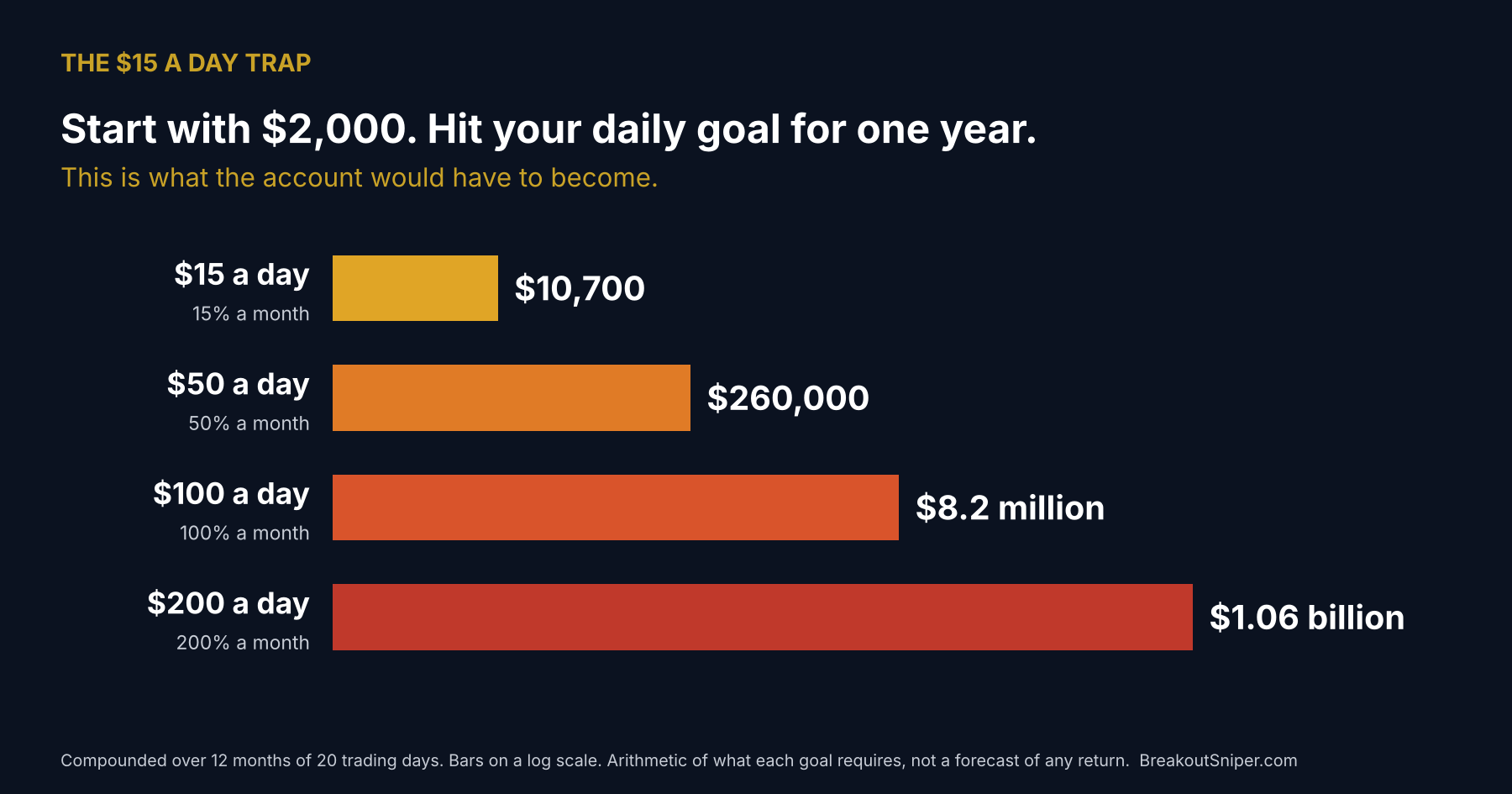
Here is a quick way to check whether any target is a plan or a fantasy. Let it run for a year.
| Daily goal | Monthly growth needed | $2,000 after 12 months |
|---|---|---|
| $15 a day | 15% | about $10,700 |
| $50 a day | 50% | about $260,000 |
| $100 a day | 100% | about $8.2 million |
| $200 a day | 200% | about $1.06 billion |
Everybody wants these numbers. They fill trading forums, YouTube thumbnails and late night daydreams. But look at them honestly. No trader on record has ever kept up anything close to this, year after year. Not the hedge fund geniuses. Not the legends in the trading books. Not one.
These are dream numbers. They live on spreadsheets and in sales pages, not in real trading accounts. And when your daily goal quietly depends on them, the goal was never a plan. It was a dream wearing a spreadsheet.
In section 6 we will put real names next to these numbers, the most famous traders in history, and you will see just how far apart they are.
These figures are arithmetic about what each goal requires. They are not a forecast of what any trader or any tool will make.
4. What A Bigger Lot Actually Does
Once the target is too big, the lot gets too big, and a big lot changes everything about how losses behave.
Losing streaks are normal. Even a sound method with an edge will hit runs of losses, often longer than you expect. So here is what a run of losses does at two different risk levels, with the risk worked out from the balance after each trade.
| Risk per trade | After 7 losses in a row | After 20 losses in a row |
|---|---|---|
| 0.5% | About 96.5% of the account left | About 90% left |
| 10% | About 48% left | About 12% left |
At 0.5%, twenty losses in a row is a bad month you can recover from. At 10%, seven losses in a row cuts the account in half, and the trader now needs to double what is left just to get back to where he started.
That is the trap. You don’t need a bad strategy to blow up. With a big enough lot, you only need time. A normal losing streak will arrive sooner or later, and the oversized account will not survive it.
It is like driving on a wet road. At 30 km/h, a skid is a fright. At 150 km/h, the same skid is a crash. The road did not change. The speed did. In trading, your lot size is your speed, and losing streaks are the wet patches you cannot see coming.
We ran 20,000 simulated traders through 200 trades at different risk levels and win rates in our guide on blowing up your trading account. If you want the full tables, that is where they live. The short version: at 0.5% risk, the chance of halving the account rounded to 0% in every scenario we tested.
5. Think In Percentages, Not Dollars
Here is where the $15 came from. On a $2,000 account, $15 is 0.75%.
Now put the same trade, the same entry, the same stop and the same skill on a $100,000 account. 0.75% of $100,000 is $750.
Nothing about the trader changed. The chart is the same. The decision is the same. The discipline is the same. Only the size of the pot changed.
A chef cooking for four people and a chef cooking for four hundred use the same recipe. The skill is in the recipe. The pot just gets bigger.
So a trader who earns 0.75% on a $2,000 account is doing exactly the same job as a trader earning $750 on a $100,000 account. The first one is not failing. He is practising the job at a smaller size.
Judge your trading in percentages. Your bank balance will catch up with your percentages, never the other way round.
6. What Is Realistic, Then?
We will not give you a number to aim for, because every trader, method and market is different, and nobody can promise any return. But here is a reference point worth knowing, and it comes from trading, not investing.
The Medallion Fund, run by Jim Simons’ Renaissance Technologies, is widely described as the most successful trading fund on record. It traded short term, used leverage, and was run by teams of mathematicians and scientists with enormous computing power. It has been widely reported to have averaged about 66% a year before fees, and about 39% a year after fees, from 1988 to 2018.
39% a year works out to roughly 2.8% a month.
Now take the individual traders. Jack Schwager’s book Market Wizards interviewed some of the most successful traders who ever lived. Here are four of them, and what their famous records work out to.
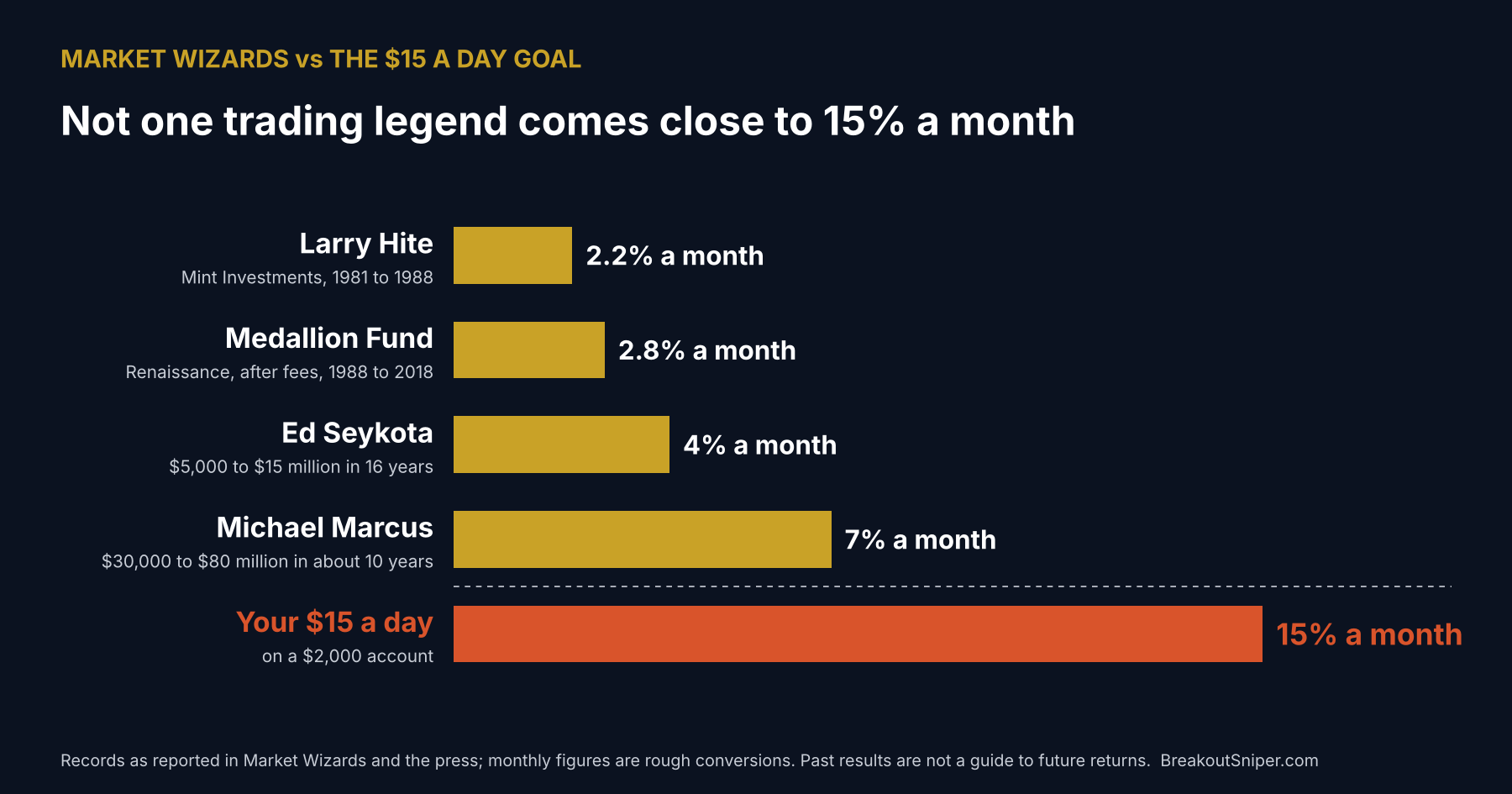
Ed Seykota, the trend following pioneer. The book reports that one of his accounts grew from $5,000 in 1972 to over $15 million by 1988. That comes to roughly 60% a year, or about 4% a month. Notice the other number in that story: 16 years. Even the legend needed time.
Michael Marcus, Seykota’s student. He is reported to have turned $30,000 into $80 million over about ten years, one of the most aggressive records in the book. Even that works out to roughly 7% a month, less than half of what the $15 a day goal demands. And by his own account, before he learned from Seykota he “was doing everything wrong.”
Larry Hite, co-founder of Mint Investments. Mint averaged about 30% a year from 1981 to 1988, roughly 2.2% a month, with yearly results ranging from a 13% loss to a 60% gain. His most famous rule will sound familiar: “Never risk more than 1 percent of total equity on any trade.” One of the greatest traders of his generation built his fortune on small risk, not big lots.
Richard Dennis, the “Prince of the Pit”. He started with a few hundred dollars of trading capital in the early 1970s and became one of the most famous traders in the world, reportedly making hundreds of millions. But he also shows the other side. He reportedly lost about $50 million over 1987 and 1988, and stepped back from managing client money after heavy losses. When even a legend pushes size too hard, the market sends the bill.
| Benchmark | Roughly per month |
|---|---|
| Larry Hite, Mint Investments | about 2.2% |
| Medallion Fund, after fees | about 2.8% |
| Ed Seykota | about 4% |
| Michael Marcus | about 7% |
| The “too small” $15 a day on $2,000 | 15% |
Look at that table carefully. These are some of the best records in trading history, built by full time professionals over many years, with losing years along the way. Not one of them comes close to 15% a month. Yet that is exactly what the $15 a day goal quietly asks of one trader with a $2,000 account and a laptop.
Think of a marathon. The fastest runners in the world finish in just over two hours, after years of training. Asking a new runner to go several times faster than that is not ambition. It is a recipe for an injury on the first kilometre. The $15 a day goal asks a new trader to run several times faster than the legends.
That is not a judgement on anyone’s ability. It is a reminder that the market does not pay small accounts extra for needing the money more.
7. The Prop Firm Illusion
Many small account traders look at prop firm challenges and think they have found the way around the problem. Trade a $100,000 challenge, and $15 becomes $750.
A challenge can be a sensible step. But it does not remove the patience problem. It tests it, with daily loss limits and maximum drawdown rules that punish oversizing even faster than your own account would. Blow the daily limit once and the challenge is over.
A challenge is like a driving test. The examiner does not care how fast you can go. He watches whether you stop at every red light. A trader who speeds through the test with big lots fails, even if he reaches the destination first.
One reader has been on our email list for more than ten years. He bought one of our older systems back then, and today he trades gold and silver on prop firm challenges. He wrote to tell us he had cleared a stage on one account, bought a fresh $100,000 challenge, and passed its first stage the same day. He said the biggest change was in the way he trades.
Then came the most honest line in his email: he hasn’t had a withdrawal yet.
That is the prop firm reality. Passing a stage proves you can follow the rules for a few weeks. It isn’t income yet. The daily loss limit is still there tomorrow, and on a funded account the patience test starts all over again. A challenge doesn’t fix impatience. It measures it.
The traders who pass are usually the ones who already trade small and steady. The challenge simply rewards a habit they built somewhere else.
8. What About The “$100 To $10,000” Challenges?
You have probably seen the videos. “Watch me turn $100 into $10,000.” A tiny account, huge lots, and a happy ending.
Here is the maths behind the happy ending. Turning $100 into $10,000 means growing the account 100 times.
| Time to do it | Growth needed every trading day |
|---|---|
| 30 trading days | about 16.6% a day |
| 60 trading days | about 8% a day |
Now do it the careful way. At 0.5% risk, a winner at 1:2 adds 1% to the account. To grow 100 times, you would need about 463 winning trades in a row, with no losses at all. Even at 2% risk and winning every trade, it would take about 233.
So the only way to finish one of these challenges in weeks is to risk a huge share of the account on every trade. That is not a strategy. It is a coin toss repeated until it lands wrong.
And notice which videos you get to see. You see the one trader whose coin landed right many times in a row. You do not see the hundreds whose accounts went to zero on day three, because nobody uploads that video. It is like judging the lottery by interviewing only the winners.
If a challenge video makes your own steady 0.5% feel slow, remember: you are comparing your whole journey with someone else’s highlight reel.
9. How To Grow A Small Forex Account: The Four Steps
So if bigger lots are the trap, what is the way out? Four steps, in this order.
Step 1: Practise the full process on a cent account
A cent account lets you trade real money with very small position sizes, so you can risk 0.5% on a small balance and still place a correctly sized trade. It is the safest place to practise the whole job: reading direction, waiting for the setup, placing the stop, sizing the lot and leaving the trade alone.
Think of it as a driving school car. It looks small, but it has a second brake on the instructor’s side. You learn every real skill on real roads, and a mistake costs cents, not your savings.
For small balances we recommend a RoboForex Cent account or an XM Micro account. These are partner links, so we may receive a commission at no cost to you.
Step 2: Fix the risk before you look at the reward
We risk at most 2 percent per trade, usually 0.5 percent. Set the stop first, then work out the lot size from the stop, never the other way round. Our free forex lot size calculator does it in seconds for any pair.
Step 3: Keep a 30 trade record
Before you change anything, whether the method, the risk or the account size, record 30 trades. Entry, stop, result, and whether you followed your rules. Thirty trades will not prove an edge on its own, but it will show you something more useful straight away: whether you can follow your own plan when nothing exciting is happening.
Pilots keep a logbook of every flight before they are trusted with bigger planes. Your 30 trade record is your logbook. It is the proof that earns the bigger account.
Step 4: Grow by deposits and proof, not by lot size
This is the part that changes everything. The fastest safe way to grow a small account is to add to it, from your salary or your business, once your record shows you are trading your plan.
Once you are certain your approach has an edge, you can climb the risk ladder slowly: 0.5%, then 1%, then 1.5%, and 2% at most, and only as a consistent trader with a sound method and real emotional control. We explain that ladder, and when to step back down, in our guide on blowing up your trading account.
The tree grows on its own schedule. Your job is to water it and keep it alive.
10. More Pairs, Not Bigger Lots
There is one more reason traders oversize, and it is not about money. It is about boredom.
If you only watch one or two pairs, good setups are rare. Days go by with nothing to do, and when a setup finally arrives, it feels like it has to count. So the lot gets bigger.
The fix is not a bigger lot on one pair. It is more charts to choose from. With 28 pairs, a clean setup on one pair is usually forming while another pair is doing nothing. You stay busy at the right size, instead of forcing size on the one chart you watch.
Think of a taxi driver. One who waits on a quiet street is tempted to overcharge the first passenger who finally turns up. One who waits at a busy station simply takes the next fare at the normal price. More charts are the busy station.
But be clear about what more pairs are for. More pairs help you find better setups, not a way to hit a daily number. If you start taking trades just to reach $15 by the end of the day, you have swapped a bigger lot for more trades, and the trap is the same.
Two rules keep that safe:
- Never more than 2 positions of the same kind or in the same direction. Four yen trades are really one bet on the yen.
- Every position gets the same small risk. The lot size changes from pair to pair. The percentage does not.
No single trade should ever make or break you.
11. The Real Purpose: A Mindset That Lasts
Everything in this guide, the table, the compounding test, the four steps, points at one thing. It is not about squeezing more out of a small account. It is about building the right mindset, because the right mindset is what keeps you in the game long enough to get good.
Trading is a journey, not a sudden spike. Most traders who quit do not quit because they lacked talent. They quit because they ran out of money before their skill had time to grow, usually after one oversized month undid a year of careful work.
Think of it like learning to swim in the sea. The traders who last are not the ones who swim out furthest on the first day. They are the ones who are still swimming ten years later.
So here is the mindset we teach, and the one we trade with ourselves:
- Defence first. Your first objective is not to make money. It is to become defensively strong and resilient, so that no losing streak can take you out of the market. Returns come later, and only to traders who are still here.
- Small enough to be calm. If you panic in every trade, the lot is still too big. At 0.5% risk, a loss is an ordinary business cost. You can place the order, set the stop and walk away, because nothing important is riding on it.
- Prove it small, then scale it. Prove your process on a small account first. Add capital when the record earns it. The account grows because you grew, not because you gambled.
- Measure the right thing. Judge each month by whether you followed your rules, not by the dollar figure. A month where you kept your rules and lost a little is a good month. A month where you broke them and won is a warning.
- Think in years, not days. “How much can I make this week?” leads to bigger lots. “How do I still trade well in five years?” leads to everything in this guide.
When the mindset is right, the pressure disappears. You stop needing the next trade, so you can wait for a good one. That patience the trader in our story thought he did not have? It was there all along. It was buried under a lot size that was too big for the account.
The goal is not to get rich quickly. It is to become a trader who cannot be knocked out, and then let time do the rest.
Let The Account Grow Up
Put it together.
The $15 a day was never the problem. It was a perfectly healthy number for a $2,000 account. The problem was the expectation that a $2,000 account should behave like a $200,000 one, and the bigger lot that expectation demanded.
Fix the expectation, and the patience follows. Keep the risk small, keep a record, add money as you prove yourself, and let your percentages do the talking.
That is the job Direction Sniper is built to support:
- Direction. One verdict from the 4 hour and the daily on every pair, so you only take trades with the bigger trend, and stand aside when the two disagree.
- Bounces that are not reversals. When the fast charts swing against the trend, the verdict holds until the bigger charts change, so you are not shaken out of a good trade by a normal pullback.
- The stop loss. Every ticket arrives with its entry, stop and three targets marked, so your lot size can be set from the stop before the trade exists. The panel then calculates and displays the trailing stop level as the trade develops, and you move your own stop to match it.
The 28 Pair Edition puts this panel on all 28 forex pairs, MT4 or MT5, on one licence, so the next setup is usually on another chart, and you don’t need a bigger lot to stay busy.
Want the strongest and weakest currencies in your inbox every trading day? Get the free Currency Strength Scanner newsletter.
More guides on reading direction, managing trades and sizing positions: Trading Guides.
Growing A Small Forex Account: Frequently Asked Questions
1How do I grow a small forex account?+
Keep the risk per trade small, at most 2 percent and usually 0.5 percent, and grow the account by adding deposits once your record shows you follow your plan.
A bigger lot speeds up losses far more than gains, so it is the fastest way to shrink a small account, not grow it.
2Is $2,000 enough to trade forex?+
Yes, $2,000 is enough to learn and practise the full process at a sensible risk. At 0.5 percent risk, each trade puts about $10 on the line.
It is not enough to replace a salary, and expecting it to is what pushes traders into oversized lots.
3How much can you make trading forex with $1,000?+
Nobody can promise a number, because results depend on the trader, the method and the market. What we can show is the arithmetic: on $1,000, 0.5 percent risk is $5 per trade.
Think in percentages rather than dollars. The skill that earns 1 percent on $1,000 is the same skill that earns 1 percent on $100,000.
4Is 10% a month realistic?+
As a steady target, very few traders sustain it. 10 percent a month compounds to more than three times the account in a year, every year.
For comparison, the Medallion Fund, widely described as the most successful trading fund on record, is reported to have averaged about 39 percent a year after fees, roughly 2.8 percent a month, and the famous Market Wizards traders, from Larry Hite to Michael Marcus, work out to roughly 2 to 7 percent a month over many years.
5What are realistic forex returns per month?+
There is no fixed realistic number, and anyone who promises one should be treated with caution. Returns vary from month to month, and losing months are normal.
A better target is a process target: risk 0.5 percent, follow your rules, and keep a record. The right mindset for a long, sustainable trading journey is defence first, so you are still trading when your skill pays off.
6Why do small account traders blow up?+
Usually because they expect a small account to pay like a big one. The only way to close that gap is a bigger lot, and a bigger lot turns a normal losing streak into a disaster.
At 10 percent risk, seven losses in a row cut the account roughly in half. At 0.5 percent, the same streak costs about 3.5 percent.
7Should I use a prop firm instead of my own small account?+
A prop firm challenge can be a sensible step, but it does not remove the patience problem. Its daily loss limits punish oversizing even faster than your own account would.
Passing a challenge stage is also not income yet. Build the small, steady habit first, then the challenge simply measures it.
8What is a cent account?+
A cent account shows your balance in cents rather than dollars, so you can place very small, correctly sized trades with real money.
It lets a small balance follow the same 0.5 percent rule as a large one. We recommend a RoboForex Cent account or an XM Micro account for small balances.
9How much should I risk per trade on a small account?+
We risk at most 2 percent per trade, usually 0.5 percent, whatever the account size. Set the stop first, then work out the lot size from the stop.
Our free forex lot size calculator does the sum in seconds for any pair.
DIRECTION SNIPER 28 PAIR EDITION
More pairs, not bigger lots.
One verdict on all 28 pairs, so the next setup is usually on another chart. Every ticket arrives with its entry, stop loss and three targets, so your lot size is set before the trade exists. MT4 or MT5, one licence.
Disclaimer: This guide is educational content, not financial advice and not a trade signal service. The tables are arithmetic showing what different goals and risk levels require, not a forecast or a promise of any return. The reader story describes one person’s experience; it is not typical and is not a guarantee of any result, and passing a prop firm challenge stage is not the same as a realised return. Figures for the Medallion Fund and for Ed Seykota, Michael Marcus, Larry Hite and Richard Dennis are as reported in the press and in Market Wizards, monthly figures are our own rough conversions, and past performance of any fund mentioned is not an indication of future results. Pip values and lot sizes depend on the pair and your broker, and are not a recommendation about how much anyone should trade. Trading forex and other leveraged products carries a high level of risk, and you should only trade money you can afford to lose.